Optimal site of pacemaker lead implantation for persistent atrial standstill guided by electroanatomical mapping following a cox-maze procedure: a case report
European Heart Journal - Case Reports


Abstract
Atrial standstill is characterized by the absence of atrial activity. We report a case of a patient with extensive atrial fibrosis who underwent electrophysiologic study (EPS) and electroanatomical mapping (EAM) to identify surviving atrial sites amenable for pacemaker lead implantation.
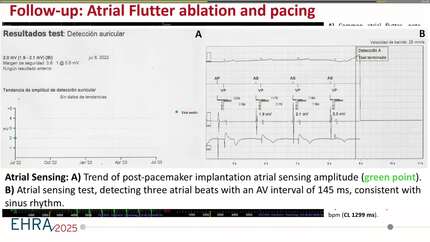
A 72-year-old man with persistent atrial fibrillation (AF) and atrial functional mitral regurgitation/tricuspid regurgitation (MR/TR) underwent a Cox-Maze surgery, mitral and tricuspid valve repair, and biatrial plication. He was referred because of post-operative presyncope symptoms. Electrocardiography revealed atrial standstill and junctional rhythm (JR); however, EAM revealed that both atria were almost entirely scarred and isolated fibrillation in left pulmonary veins and coronary sinus. Junctional rhythm retrogradely conducted around an atrioventricular (AV) node and pacing at this area could conduct to the ventricle through the AV node. An atrial pacing lead was implanted at this area, which yielded a QRS wave similar to the own beat. However, the atrial lead voltage was quite low; hence, ventricular pacing lead was implanted to avoid a future occurrence of pacing failure.
This report demonstrates the benefits of EPS and EAM in informing optimal pacemaker implantation for patients with extensive scar in atrium.
Contributors

Sae Ujiro
Author
Soichiro Yamashita
Author
Makoto Takemoto
Author
Masanori Okuda
Author
Stefan Simovic
Author
Vera Maslova
Author
Ugur Canpolat
Author
Faris Kadic
Author
You may be interested in