Fasting vs. no fasting prior to catheterization laboratory procedures: the SCOFF trial
European Heart Journal


Abstract
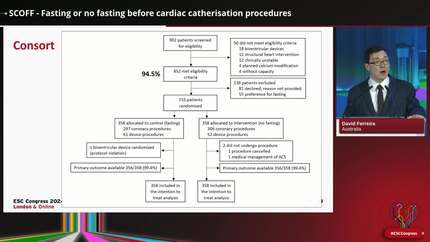
Current guidelines recommend 6 h of solid food and 2 h of clear liquid fasting for patients undergoing cardiac procedures with conscious sedation. There are no data to support this practice, and previous single-centre studies support the safety of removing fasting requirements. The objective of this study was to determine the non-inferiority of a no-fasting strategy to fasting prior to cardiac catheterization procedures which require conscious sedation.
This is a multicentre, investigator-initiated, non-inferiority, randomized trial conducted in Australia with a prospective open-label, blinded endpoint design. Patients referred for coronary angiography, percutaneous coronary intervention, or cardiac implantable electronic device (CIED)-related procedures were enrolled. Patients were randomized 1:1 to fasting as normal (6 h solid food and 2 h clear liquid) or no-fasting requirements (encouraged to have regular meals but not mandated to do so). Recruitment occurred from 2022 to 2023. The primary outcome was a composite of aspiration pneumonia, hypotension, hyperglycaemia, and hypoglycaemia assessed with a Bayesian approach. Secondary outcomes included patient satisfaction score, new ventilation requirement (non-invasive and invasive), new intensive care unit admission, 30-day readmission, 30-day mortality, 30-day pneumonia.
A total of 716 patients were randomized with 358 in each group. Those in the fasting arm had significantly longer solid food fasting (13.2 vs. 3.0 h, Bayes factor >100, indicating extreme evidence of difference) and clear liquid fasting times (7.0 vs. 2.4 h, Bayes factor >100). The primary composite outcome occurred in 19.1% of patients in the fasting arm and 12.0% of patients in the no-fasting arm. The estimate of the mean posterior difference in proportions with credibility interval (CI) in the primary composite outcome was −5.2% (95% CI −9.6 to −.9), favouring no fasting. This result confirms the non-inferiority (posterior probability >99.5%) and superiority (posterior probability 99.1%) of no fasting for the primary composite outcome. The no-fasting arm had improved patient satisfaction scores with a posterior mean difference of 4.02 points (95% CI 3.36–4.67, Bayes factor >100). Secondary outcome events were observed to be similar.
In patients undergoing cardiac catheterization and CIED-related procedures, no fasting was non-inferior and superior to fasting for the primary composite outcome of aspiration pneumonia, hypotension, hyperglycaemia, and hypoglycaemia. Patient satisfaction scores were significantly better with no fasting. This supports removing fasting requirements for patients undergoing cardiac catheterization laboratory procedures that require conscious sedation.
Contributors

Bradley Wilsmore
Author

Jack Hardy
Author
William Meere
Author
Lloyd Butel-Simoes
Author
Shanathan Sritharan
Author
Max Ray
Author
Matthew French
Author
Michael McGee
Author
Simon O’Connor
Author
Nicholas Whitehead
Author
Stuart Turner
Author
Paul Healey
Author
Allan Davies
Author
Gwilym Morris
Author
Nicholas Jackson
Author
Malcolm Barlow
Author
Tom Ford
Author
Sarah Leask
Author
Christopher Oldmeadow
Author
John Attia
Author
Aaron Sverdlov
Author
Nicholas Collins
Author
Andrew Boyle
Author
You may be interested in