Infective endocarditis with or without congenital heart disease: clinical features and outcomes
European Heart Journal


Abstract
Patients with congenital heart disease (CHD) form a high-risk subgroup for infective endocarditis (IE), necessitating tailored prevention and treatment strategies. However, comprehensive nationwide data comparing IE characteristics and outcomes in patients with and without CHD, including children, are sparse. This study aims to address this gap in knowledge.
Using Danish nationwide registries, all patients with IE from 1977 to 2021 were identified and stratified on whether they had a diagnosis of CHD, regardless of its complexity. Characteristics prior to and during admission as well as associated outcomes (i.e. in-hospital mortality, 1-year mortality, and 10-year mortality, and IE recurrence) were compared between groups.
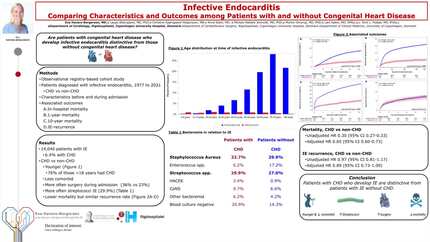
In total, 14 040 patients with IE were identified, including 895 (6.4%) with CHD. Patients with vs. without CHD were younger at the time of IE diagnosis (median age 38.8 vs. 70.7 years), less comorbid, and more frequently underwent cardiac surgery during admission (35.7% vs. 23.0%,
Patients with CHD who develop IE exhibit distinct characteristics and improved long-term outcomes compared with patients without CHD. Notably, the majority of children and adolescents with IE have underlying CHD.
Contributors

Eva Havers-Borgersen
Author
Lauge Østergaard
Author
Anna Stahl
Author
Michael Rahbek Schmidt
Author
Morten Smerup
Author
Lars Køber
Author
Emil L Fosbøl
Author
You may be interested in