Serial shock severity assessment within seventy-two hours after diagnosis: a cardiogenic shock working group report
European Heart Journal


Abstract
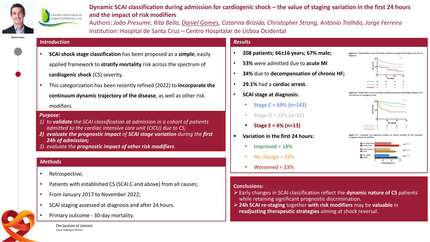
The Cardiogenic Shock Working Group-modified Society for Cardiovascular Angiography and Interventions (CSWG-SCAI) staging was developed to risk stratify cardiogenic shock (CS) severity. Data illustrating progressive changes in SCAI stages and outcomes are limited.
We investigated serial changes in CSWG-SCAI stages and outcomes of patients presenting with myocardial infarction- (MI-CS) and heart failure-related (HF-CS) cardiogenic shock.
The multi-center CSWG registry was queried. CSWG-SCAI stages were computed at CS diagnosis (baseline, 0 hour) and subsequently at 24, 48, and 72 hours.
A total of 3268 patients (57% HF-CS, 27% MI-CS) were included. On admission, CSWG-SCAI stage breakdown was: 593 (18.1%) B, 528 (16.2%) C, 1659 (50.8%) D, and 488 (14.9%) non-cardiac arrest stage E (Fig. A). At 24 hours, >50% of stages B and C patients worsened, but 86% of stage D patients stayed at stage D. Among stage E patients, 54% improved to stage D and 36% stayed at stage E by 24 hours. Minimal change in SCAI stages occurred beyond 24 hours. SCAI stage trajectories were similar between MI-CS and HF-CS groups. Notably, stage B patients who worsened to stage C had similar mortality to those remaining at stage C (25.9% vs. 15.8%, p=0.1). Stage B patients worsening to stage D also had similar mortality to stage C patients worsening to stage D (27.4% vs. 25%, p=0.6) (Fig. B). Stage B subjects who remained at stage B by 24 hours still had a 20% in-hospital mortality. Patients who presented in or progressed to stage E by 24 hours had the highest rates of mortality.
Most patients with CS changed SCAI stages within 24 hours from CS diagnosis. Stage B patients were at high risk of worsening shock severity by 24 hours, associated with excess mortality. Early CS recognition and serial assessment may improve risk stratification.




You may be interested in