Phenotype groups in atrial cardiomyopathy and their prognosis
European Heart Journal


Abstract
Atrial cardiomyopathy (ACM) includes patients with heterogenous demographic characteristics and comorbidities. Defining phenotype groups with similar clinical characteristics is important for the effective treatment of these patients, and for their prognosis and prevention of ACM.
To conduct a cluster analysis that could help us in phenotyping ACM and exploring the clinical complexity of this entity.
We performed a hierarchical cluster analysis based on Ward’s Method using 10 clinical binary variables (hypertension, diabetes mellitus, heart failure, obesity, chronic obstructive pulmonary disease, cancer, coronary artery disease, sinus node dysfunction or atrio-ventricular block, implanted pacemaker, and ischemic stroke), identifying the optimal number of clusters. We investigated differences in demographic, laboratory and echocardiographic parameters, and treatment between defined clusters, and assessed the impact of these factors on prognosis.
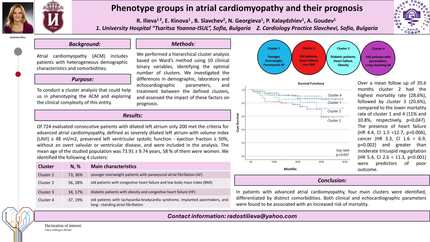
Of 724 evaluated consecutive patients with dilated left atrium only 200 met the criteria for advanced atrial cardiomyopathy, defined as severely dilated left atrium with volume index (LAVI) ≥ 48 ml/m2, preserved left ventricular systolic function - ejection fraction ≥ 50%, without an overt valvular or ventricular disease, and were included in the analysis. Mean age of the studied population was 73.91 ± 9.74 years, 58 % of them were women. We identified 4 clusters: cluster 1 (n = 73, 36%) were younger overweight patients with paroxysmal atrial fibrillation (AF); cluster 2 (n = 56, 28%) - old patients with congestive heart failure (CHF) and low body mass index (BMI); cluster 3 (n = 34, 17%)- diabetic patients with obesity and CHF; and cluster 4 (n = 37, 19%) old patients with tachycardia-bradycardia syndrome, implanted pacemakers, and long -standing AF. Over a mean follow up of 20.6 months cluster 2 had the highest mortality rate (28.6%), followed by cluster 3 (20.6%), compared to the lower mortality rate of cluster 1 and 4 (11% and 10.8%, respectively, p=0.047). The presence of heart failure (HR 4.4, CI 1.5 ÷12.7, p=0.006), cancer (HR 3.3, CI 1.6 ÷ 6.9, p=0.002) and greater than moderate tricuspid regurgitation (HR 5.4, CI 2.6 ÷ 11.3, p<0.001) were predictors of poor outcome.
In patients with advanced atrial cardiomyopathy, four main clusters were identified, differentiated by distinct comorbidities. Both clinical and echocardiographic parameters were found to be associated with an increased risk of mortality. Phenotype clusters of ACM Kaplan-Meier curves of clusters
Contributors




You may be interested in