Association of gut microbiota imbalance with risk of postoperative infections in patients with left ventricular assist device
European Heart Journal


Abstract
Infections are the most common complications following left ventricular assist device (LVAD) implantation and associated with adverse events. Gut microbial imbalance may predispose to mucosal colonization with pathogens, resulting in a risk of subsequent serious infections. However, it remains unclear whether gut microbiota imbalance is associated with postoperative infections in patients with LVAD.
The aim of this study was to investigate whether gut microbiota imbalance was associated with postoperative infections in patients with LVAD.
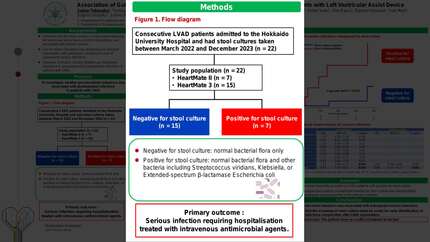
We prospectively examined 22 consecutive LVAD patients who were admitted to a university hospital for routine check-ups and had stool cultures taken between March 2022 and December 2023. All patients had no signs of infection. The patients were divided into two groups according to positive (normal bacterial flora and other bacteria including Streptococcus viridans, Klebsiella, or Extended-spectrum β-lactamase Escherichia coli; n = 7) and negative (normal bacterial flora only; n = 15) for stool culture. The primary outcome was serious infection requiring hospitalisation treated with intravenous antimicrobial agents.
Patients were predominantly male (68%) and the median age was 49 (interquartile range [IQR] 29-58) years. There were no significant differences in age, sex, primary aetiology of heart failure, type of LVAD devices, time on LVAD support, the history of infection, or antibiotics use within six months between the groups. During a median follow-up period of 316 days (IQR 242-559), the primary outcome occurred in seven patients (32%), including four hospitalisation for driveline infections, two pneumoniae and bacterial bloodstream infections, and one lung abscess and bacterial bloodstream infection. Kaplan–Meier analysis showed that the adverse events more frequently occurred in LVAD patients with positive for stool culture (P = 0.010) (Figure). A multivariable Cox regression analysis showed that positive for stool culture was independently associated with an increased subsequent risk of the primary outcome (hazard ratio 6.99, 95% confidence interval 1.17-41.7, P = 0.033), even after adjustments for age, male, body mass index, diabetes, INTERMACS profile, mechanical circulatory support, serum creatinine, serum albumin, and white blood cell count, which are known to be strong determinants of worse clinical outcomes in patients with LVAD.
In patients with LVAD, gut microbial imbalance was associated with subsequent serious infections. These findings suggest that the screening of stool culture might be useful for early identification of high-risk patients for infectious complication after LVAD implantation.
Contributors

T Nagai
Author
T Sato
Author
K Kamiya
Author
Y Mizuguchi
Author
Y Takahashi
Author
S Naito
Author
K Saiin
Author
S Kazui
Author
T Hamaya
Author
Y Mori
Author
S Ishizaka
Author
S Wakasa
Author
T Anzai
Author
You may be interested in