A meta-analysis of the efficacy and safety of exercise-based cardiac rehabilitation in patients with left ventricular assist devices
European Heart Journal


Abstract
Left Ventricular Assist Devices (LVADs) and heart transplantation stand out as the two well-established and effective therapeutic approaches for managing patients with advanced heart failure. Exercise-based cardiac rehabilitation (EBCR) has been demonstrated to improve functional capacity in patients with LVAD.
We aim to assess the efficacy and safety of EBCR in patients with LVAD. Also, to compare high-intensity (HIT) versus moderate-intensity (MIT) EBCR regimens in patients with LVAD.
A systematic review and meta-analysis synthesizing evidence from randomized controlled trials (RCTs) studies obtained from PubMed, Embase Cochrane, Scopus, and WOS until January 2024. We used the fixed-effects model to report dichotomous outcomes using risk ratio (RR) and continuous outcomes using standardized mean difference (SMD) with a 95% confidence interval (CI).
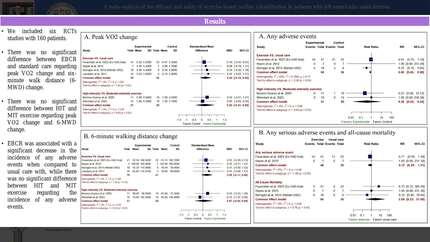
Six RCTs with 160 patients were included. There was no significant difference between EBCR and standard care regarding peak VO2 change [SMD: 0.24 with 95% CI (-0.14, 0.62), P= 0.21] and six-minute walk distance (6-MWD) change [SMD: 0.28 with 95% CI (-0.11, 0.66), P= 0.16]. Also, there was no significant difference between HIT and MIT exercise regarding peak VO2 change [SMD: 0.20 with 95% CI (-0.41, 0.82), P= 0.52] and 6-MWD change [SMD: 0.07 with 95% CI (-0.54, 0.69), P= 0.81]. Moreover, EBCR was associated with a significant decrease in the incidence of any adverse events when compared to usual care with [RR: 0.80 with 95% CI (0.65, 0.99), P= 0.04], while there was no significant difference between HIT and MIT exercise regarding the incidence of any adverse events [RR: 0.38 with 95% CI (0.02, 9.22), P= 0.55].
EBCR did not improve functional capacity in patients with LVAD, with no significant effect on peak VO2 or 6-MWD.
Contributors


You may be interested in