Long-term safety and efficacy of antibody ALXN2220 for depletion of cardiac amyloid transthyretin: results of treatment beyond 12 months in the open-label extension of study NI006-101
European Heart Journal


Abstract
ALXN2220 (formerly NI006) is an investigational human monoclonal antibody in development for the treatment of transthyretin-mediated amyloid cardiomyopathy (ATTR-CM). ALXN2220 is designed to deplete cardiac amyloid transthyretin (ATTR) deposits in patients with ATTR-CM on top of standard of care. Data from the first-in-human, ascending dose study NI006-101 show that ALXN2220 is safe and well tolerated. A reduction of surrogate markers of cardiac amyloid load and cardiac biomarkers was observed in participants receiving doses of ≥ 10mg/kg of ALXN2220 over a period of 12 months of treatment.
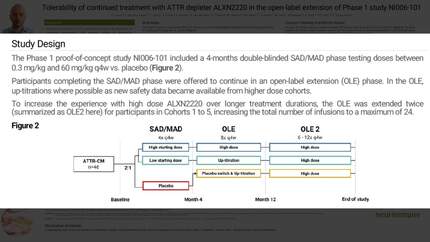
Long-term safety, tolerability and efficacy of ALXN2220 treatment beyond 12 months was studied in a prolonged Open-Label Extension (OLE) of the NI006-101 study.
Participants completing 12 months in dose cohorts ≤ 30 mg/kg were allowed to receive additional 6 to 12 monthly open-label ALXN2220 infusions with up-titration of all participants to 30 mg/kg. Cardiac biomarkers were measured centrally, and serial cardiac imaging was performed with echocardiography and cardiac MRI or scintigraphy.
Out of 27 participants completing 12 months, 23 (18 ATTRwt, all male, median age 70 years at screening (range 28-83)) continued treatment in the prolonged OLE. Median number of infusions of ALXN2220 received and median time followed across the full study were 20 infusions (range 11-24) and 125 weeks (range 83-153). Overall adherence to treatment was high in the prolonged OLE, 97% of planned infusions administered, 87% of participants received all planned doses. No severe or serious adverse events were considered related to ALXN2220 or resulted in the discontinuation during OLE, and no events of cytokine release syndrome or thrombocytopenia were observed. None of the participants had anti-drug antibodies throughout the trial. Cardiac biomarkers (NT-proBNP, troponin) and cardiac imaging indicated continued treatment effects beyond 12 months and supported the up-titration of participants who previously received lower doses of ALXN2220.
Up-titration and long-term treatment at a dose level of 30 mg/kg in the OLE was safe and well tolerated, with overall good adherence to treatment. Cardiac imaging and cardiac biomarker data indicated continued treatment effects beyond 12 months and supported the up-titration of patients to 30 mg/kg.
Contributors

P Van Der Meer
Author
O Lairez
Author
E Donal
Author
F Aus Dem Siepen
Author
A Kristen
Author
T Damy
Author
C Quarta
Author
M Mercuri
Author
R M Nitsch
Author
J Grimm
Author
S Rey
Author
M Tichy
Author
C Hock
Author
P Garcia-Pavia
Author
You may be interested in