Real-life data on the tolerability of SGLT2 inhibitors in elderly patients with heart failure
European Heart Journal


Abstract
Sodium-glucose co-transporter 2 inhibitors (SGLT2i) have demonstrated their effectiveness in improving the prognosis of heart failure. However, there is some hesitation in clinical practice to prescribe them to elderly patients due to a lack of long-term safety data. The SafeGLT2 study aims to evaluate the tolerance of SGLT2i in elderly patients with heart failure in real-life settings.
This is a prospective study conducted in acute geriatric units in the Île-de-France region between February 2020 and May 2023. All patients admitted for acute heart failure (AHF), aged 75 years and older, were included. The diagnosis was confirmed by an expert committee, and patients were followed for one year. Treatments were recorded upon admission and discharge, along with demographic characteristics and medical history. SGLT2i tolerance data were collected and analyzed, including renal insufficiency, hypovolemia, genital infections, urinary infections, hypoglycemia, diabetic ketoacidosis, fractures, amputations, etc. A comparison of tolerance data between heart failure patients treated with SGLT2i and those not receiving SGLT2i was performed.
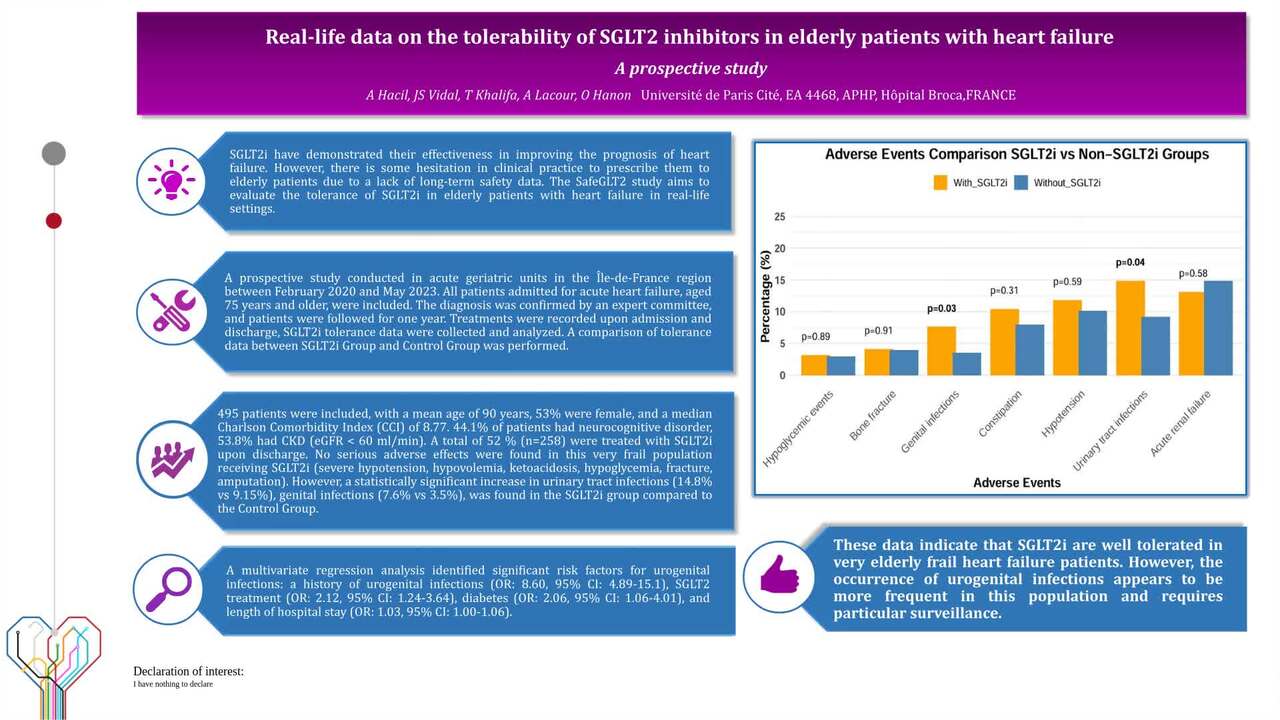
288 patients were included in the study with a mean age of 88 years, 53% (n=153) were female, and a median Charlson Comorbidity Index (CCI) of 8.77 [2.71]. 44.1% (n=127) of patients had neurocognitive disorders, 39.6% (n=114) were malnourished, 32.6% (n=94) were fallers, 53.8% (n=155) had renal insufficiency (eGFR < 60 ml/min), and 11.5% (n=33) lived in institutions. A total of 33% (n=95) were treated with SGLT2i upon discharge. No serious adverse effects were found in this very frail population receiving SGLT2i compared to the group not receiving SGLT2i (severe hypotension, hypovolemia, ketoacidosis, hypoglycemia, fracture, amputation). Beneficial effects on renal function (improvement of renal function at 6 months) were observed in the SGLT2i group despite a temporary decrease in glomerular filtration rate of less than 30% after SGLT2i initiation. However, a statistically significant increase in urinary tract infections (16.8% vs 4.15%), genital infections (12.6% vs 1.5%), and constipation (10% vs 1%) was found in the SGLT2i group compared to the group without SGLT2i.
These data indicate that SGLT2i are well tolerated in very elderly frail heart failure patients. However, the occurrence of urogenital infections appears to be more frequent in this population and requires particular surveillance.


You may be interested in