Serial changes of 99mTc- pyrophosphate uptake in patients with hereditary transthyretin amyloid cardiomyopathy treated with tafamidis
European Heart Journal


Abstract
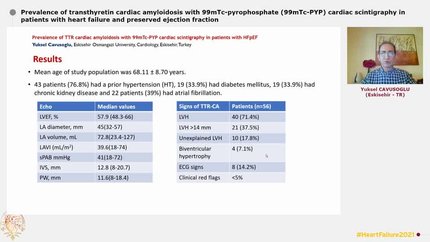
Transthyretin amyloid cardiomyopathy (ATTR-CM) arises from the deposition of amyloid in the heart, resulting in adverse outcomes. Tafamidis has demonstrated potential in slowing disease progression. Our research group, alongside others, has documented cases where decrease in cardiac tracer uptake were observed through bone scintigraphy after tafamidis treatment.[1-8] This study aims to assess the efficacy of Technetium-99m (99mTc)-pyrophosphate (PYP) scintigraphy in longitudinally monitoring tafamidis treatment for hereditary ATTR-CM over an extended follow-up period.
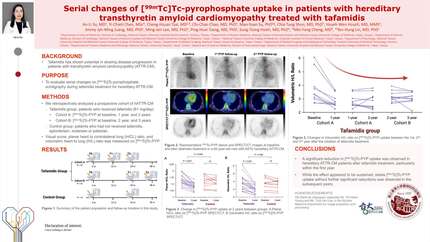
We retrospectively analyzed a prospective cohort of hereditary ATTR-CM patients treated with tafamidis (61 mg/day) retrospectively. A control group comprised hereditary ATTR-CM patients who hadn't received eplontersen, inotersen, tafamidis, or patisiran. 99mTc-PYP SPECT/CT scans were conducted at baseline and 1-3 years post-treatment, measuring visual score, planar heart to contralateral lung (H/CL) ratio, and volumetric heart to lung (H/L) ratio.
Twenty hATTR-CM patients received tafamidis, with the other ten in the control group. After a 2-year follow-up, the tafamidis group experienced a significant decrease in volumetric heart to lung (H/L) ratio (3.817 to 3.011, p < 0.001), while the control group showed no significant change (3.775 to 3.621, p = 0.121)(Figure 1B). Significant decreases in volumetric H/L ratio were noted in the first year of tafamidis treatment (-21.71%), with minimal changes in the subsequent two years (-0.77% in the second year and -2.41% in the third year)(Figure 2B).
A significant initial reduction in 99mTc-PYP uptake was observed in hereditary ATTR-CM patients during the first year of tafamidis treatment. However, this effect was not sustained in the subsequent two years. Further investigation is warranted to comprehend the long-term efficacy of tafamidis in these patients. Changes in 99mTc-PYP uptake at 2 years Changes between 1st, 2nd and 3rd year


You may be interested in