The effects of SGLT2 inhibitors on right ventricle functions in heart failure patients: update meta-analysis of the current literature
European Heart Journal


Abstract
There is some discrepancy in the present studies concerning the effect of sodium-glucose cotransporter type 2 (SGLT2) inhibitors on right ventricular (RV) functions in heart failure (HF) patients. The current meta-analysis was focused on determining the impact of SGLT2 inhibitors on RV functions in such individuals.
Two independent investigators searched PubMed, Google Scholar, and the Cochrane Library for articles of interest. To analyze heterogeneity, Higgins' I2 as well as prediction intervals and Egger's test were utilized to assess heterogeneity. The Newcastle-Ottawa standard ratings approach was used to assess the quality of observational studies. The Robin-I risk of bias algorithm was used to assess the bias risks of randomized studies.
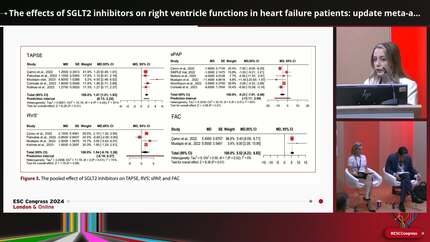
This meta-analysis evaluated 8 studies in total. Over the follow-up time frame, patients who used SGLT-2 inhibitors had substantially lower systolic pulmonary artery pressure (sPAP) and higher TAPSE values (mean difference (MD) = 1.30 [0.78;1.82], p =0.002 and MD =-5.39 [-7.88; -2.89], p=0.003, respectively). There was no significant difference in RVS’ values between follow-up and baseline (MD=1.38 [-1.35;3.80], p=0.169). However, as compared to the baseline period, fractional area contraction (FAC) values were substantially larger at the end of the follow-up period (MD=5.40 [3.74;7.07], p=0.015).
To the best of our knowledge, this is the first meta-analysis assessing the impact of SGLT2 inhibitors on RV function in HF patients. Our findings suggest that SGLT2 inhibitors may improve RV performance in HF patients.
Contributors


F Saylik
Author
V C Cicek
Author
Northwestern University Feinberg School of Medicine Chicago , United States of America
L Pay
Author
A Khachatryan
Author
J Alejandro
Author
A Erdem
Author
M I Hayiroglu
Author
You may be interested in