Automated digital counselling with social network support for chronic heart failure fails to improve health status but promotes health-related quality of life: ODYSSEE-vCHAT pilot trial
European Heart Journal


Abstract
Automated digital counselling programs have the potential to provide a scalable, complementary behavioural intervention to improve clinical outcomes for chronic heart failure (CHF).
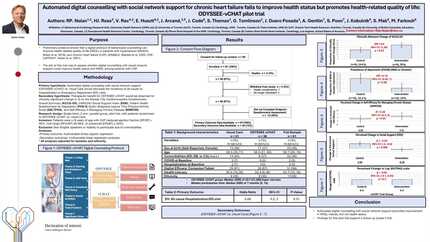
The primary hypothesis for this pilot trial was that automated digital counseling with social network support (ODYSSEE-vCHAT) vs. Usual Care would decrease the incidence of all-cause re-hospitalization or ED visits. Secondary outcomes included: minimal clinically important difference for improvement on the Kansas City Cardiomyopathy Questionnaire-Overall Summary (KCCQ-OS), and improvement on ENRICHD Social Support Index (ESSI), Patient Health Questionnaire for Depression (PHQ-9) Godin-Shephard Leisure Time Physical Activity Scale (GSLTPAQ), and Self-Efficacy in Managing Chronic Disease (SEMCD6).
This 2-arm, parallel group, single-blind pilot trial randomized patients to ODYSSEE-vCHAT vs. Usual Care. Patients were ≥18 years of age with CHF (reduced ejection fraction [HFrEF] < 40%, mid-range [HFmrEF] 40-49%, or preserved [HFpEF] ≥ 50%). Exclusion was based on inability to participate due to co-morbidities. All-cause hospitalization or ED visit were assessed digitally by hospital administrative data. Questionnaires were administered at baseline and end-of-study (approximately 8 months). The digital counselling protocol aimed to improve CHF self-care, HRQL, and adherence to medications, exercise, diet, and smoke-free living (Figure 1). The primary outcome was assessed using multivariable binary logistic regression. Secondary outcomes were assessed using multivariable linear regression analyses with ethno-racial group as a covariate.
61 patients were randomized: ODYSSEE-vCHAT, n = 30 (49%), vs. Usual Care, n = 31 (51%). There were 2 deaths, 3 withdrawals, and 12 patients failed to complete secondary outcome assessments. Sample characteristics included mean age = 59 years (95% Confidence Interval, CI, 30, 76), gender identity as women, n = 23 (38%), ethno-racial group other than White, n = 17, (28%) and CHF with HFrEF, n = 47 (77%), HFmrEF, n = 8 (13%), and HFpEF, n = 4 (7%). Duration of enrollment to trial endpoint: mean = 247 days, (95% CI, 75, 382). Figure 2 indicates that ODYSSEE-vCHAT was not associated with lower incidence of all-cause hospitalization/ED visit: composite index events for Usual Care, n = 8 (28%), ODYSSEE-vCHAT, n = 7 (23%). However, ODYSSEE-vCHAT was associated with greater prevalence of KCCQ-OS change (≥ 5 points), and greater improvement in self-efficacy (SEMCD6) for managing CHF. There was a statistical trend to decreased prevalence of depression. Social support was inversely associated with ODYSSEE-vCHAT. No benefit was observed for physical activity (Figure 2).
Automated digital counselling with social network support promotes improvement in HRQL indices, but not health status. Findings for this pilot trial support a follow-up phase 2 randomized controlled trial. Digital Counselling Protocol ODYSSEE-vCHAT Outcomes
Contributors



V Rac
Author
E Huszti
Author

J Code
Author
G Tomlinson
Author
J Duero Posada
Author
A Gentlin
Author
S Poon
Author
J Kobulnik
Author
S Mak
Author
M Farkouh
Author
You may be interested in