Heart failure hospitalization reduction and long-term safety with remote pulmonary artery pressure monitoring: results of the CardioMEMS HF System OUS Post-Market Study
European Heart Journal


Abstract
Heart failure (HF) is increasing in prevalence and is responsible for frequent hospitalization and readmissions, despite current guideline recommended therapies. Hemodynamic guided HF management using frequently remotely obtained pulmonary artery (PA) pressure information using a permanently implanted PA sensor (CardioMEMSTM HF System, Abbott) consistently reduced HF hospitalizations (HFH) in multiple healthcare settings.
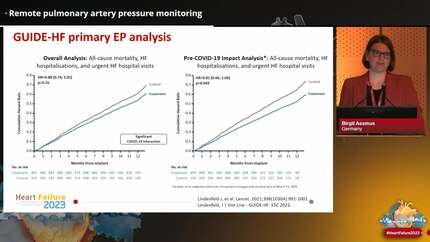
The safety and efficacy of the CardioMEMS HF System has been shown previously in several clinical studies, which reported significant reductions in HFH compared to a control (CHAMPION: 33%, 18M; GUIDE-HF: 28%, 1 yr; and MONITOR-HF: 44%, 1 yr) and longitudinally (MEMS-HF: 62%, 1 yr; and CardioMEMS US PAS: 57%, 1 yr) across varying health systems.
The CardioMEMS HF System OUS Post-Market Study (COAST) aimed to evaluate the safety and effectiveness of hemodynamic guided HF management in patients with NYHA Class III HF in varying health systems across Europe and Australia.
COAST is a prospective, multi-centre, open-label clinical trial that consented 321 patients at 38 European and Australian centres. The primary endpoint is a combination of safety (freedom from DSRCs and freedom from pressure sensor failure at 2 years after implant) and efficacy endpoints (annualized HFH rate at 1-year vs the HFH rate in the year prior to enrolment). In this analysis we report these primary results of the study.
Out of 321 consented patients, 17 subjects were withdrawn before implant, while the PA sensor was implanted successfully in 299 out of 304 patients who underwent the procedure (98.3% success rate). Seventy-three percent (73%) of the patients were male, the mean age was 68.4±11.7 years with ischemic cardiomyopathy in 45.4%. At baseline, all patients had NYHA Class III symptoms and an average EQ-5D-5L VAS score of 60.0±21.6. After 2 years follow-up there was 100% freedom from DSRCs and 99.7% freedom from pressure sensor failure. The annualized HFH rate after 1 year decreased by 69%, from 1.586 (pre-implant) to 0.488 (post-implant) (p<0.0001). The patient’s quality of life (EQ-5D-5L VAS) increased 8.1 units (68.2 ± 20.1, p=0.0008).
The COAST Study demonstrated that hemodynamic-guided remote HF management using PA pressure information is both safe and effective, with consistent implant safety and low risk for long-term sensor failure. At 1 year post implant, HFH were significantly reduced and quality of life improved. These results are also consistent with long-term clinical follow-up (2 yr) in other geographies with no late-stage adverse events or adverse events from sensor implant, demonstrating the generalizability of this type of hemodynamic-guided HF management.
Contributors


S Mckenzie
Author
A Flett
Author
P Folley
Author
K Rossing
Author
M Ciccarelli
Author
A C Pouleur
Author
C Gazzola
Author
E Park
Author
P B Adamson
Author

You may be interested in