Cardiac contractility index, a novel biomarker of incident heart failure amongst people with normal left ventricular ejection fraction in the UK Biobank
European Heart Journal


Abstract
Cardiac contractility index (CCI) is a simple non-invasive measure of myocardial contractility defined by systolic blood pressure divided by indexed left ventricular end-systolic volume. Although left ventricular ejection fraction (LVEF) is essential for phenotyping patients with suspected heart failure (HF), it is load dependent and insensitive to subtle subclinical ventricular dysfunction. Left ventricular (LV) strain, although more sensitive at detecting subtle disturbances in myocardial function, also does not reflect loading conditions and dependency on image quality and inter-vendor variability limit widespread use. The ability of CCI to identify patients with subclinical left ventricular dysfunction at risk of developing HF is unknown.
We aimed to: 1) explore the relationship between CCI with conventional imaging biomarkers of LV systolic dysfunction and 2) assess whether CCI could identify those at increased risk of incident HF in people without pre-existing left ventricular dysfunction in the UK Biobank imaging study.
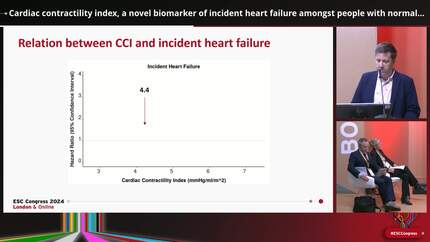
We explored the relationship between CCI and laboratory and imaging biomarkers of systolic function, including LVEF and LV strain. Scatter plots were constructed for CCI with LVEF and LV strain. Pearson’s coefficients (r) and coefficient of determination (r2) were calculated to assess for correlations. People with sex-specific thresholds of abnormally low LVEF derived from within the same cohort (<48% for men, and <51% for women) were then excluded. CCI was then dichotomised as being high or low based its median value (4.4 mmHg/ml/m2). Age-sex adjusted Cox proportional hazards ratios (HR) with 95% CIs were estimated for the primary outcome of incident HF (derived from linked national digital registries) in addition to modelling with restricted cubic splines.
We included 38,215 people (median age 55 years, 48% men). There was moderate correlation between CCI with LVEF (r=0.53 [0.53-0.54], R2=0.29; p<0.001), LV global circumferential strain (r=-0.50 [-0.50- -0.49], R2=0.25; p<0.001) and radial strain (r=-0.49 [0.48-0.50], R2=0.24; p<0.001), although was only weekly correlated with LV global longitudinal strain (r=-0.19 [-0.20- -0.18], R2=0.03; p<0.001) (Figure 1A). Using sex-specific thresholds 33,739 (88.3%) had a normal LVEF. During 195,584 person-years of follow-up (median 5.5 years), a total of 221 (0.7%) participants developed HF. Age-sex adjusted low CCI at baseline was associated with an increased risk of incident HF (adjusted HR 1.33 [1.01-1.75]; p=0.043). The association between CCI and incident HF was curvilinear (Figure 1B).
CCI identifies people with subclinical left ventricular systolic dysfunction at risk of developing incident heart failure.
Contributors

S Straw
Author
M Drozd
Author
M Conning-Rowland
Author
S Kamalathasan
Author
J Lowry
Author
M F Paton
Author
T A Slater
Author
E Levelt
Author
M T Kearney
Author
K K Witte
Author
R M Cubbon
Author
J Gierula
Author
O I Brown
Author
You may be interested in