Survival in patients with chronic congestive heart failure and correlation of presence of risk factors and all-cause mortality
European Heart Journal


Abstract
Right heart function is known to be an independent risk factor for early mortality in patients with acute and chronic heart failure (HF). The prognostic value of cardiopulmonary exercise testing (CPET) is established for risk stratification in patients with Heart Failure. Further, markers of inflammation may predict clinical outcomes.
We performed a single-center retrospective analysis of a large single center cohort and assessed all-cause mortality. A simple score including presence of RVD, systemic inflammation and reduced O2 uptake was applied to all patients and a subgroup survival analysis was performed.
A total of 612 patients with HF across the whole spectrum of left ventricular ejection fraction (LVEF) were analyzed. We stratified patients according to RV function, peak relative oxygen consumption in ml/min/kg (VO2max) and CRP levels. Patients were classified as RV Dysfunction when a right ventricular dilation (RVEDD > 40 mm or RVOT > 30 MM) or decreased tricuspid annular systolic excursion (TAPSE < 17 mm) was seen in the echocardiography. All patients were followed up by phone or by hospital records if available. The primary end-point of all-cause mortality was assessed.
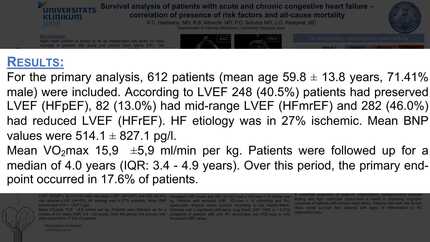
For the primary analysis, 612 patients (mean age 59.8 ± 13.8 years, 71.41% male) were included. According to LVEF 248 (40.5%) patients had preserved LVEF (HFpEF), 82 (13.0%) had mid-range LVEF (HFmrEF) and 282 (46.0%) had reduced LVEF (HFrEF). HF etiology was in 27% ischemic. Mean BNP values were 514.1 ± 827.1 pg/l. Mean VO2max 15,9 ± 5,9 ml/min per kg. Patients were followed up for a median of 4.0 years (IQR: 3.4 - 4.9 years). Over this period, the primary end-point occurred in 17.6% of patients. 135 (22%) of patients had evidence of RV dysfunction, 26% had increased CRP-levels and 256 (41.8%) had a VO2max < 14 ml/min per kg. Patients with elevated CRP, VO2max < 14 ml/min/kg and RV-dysfunction showed worse survival according to the Kaplan-Meier-Estimate with a significant difference (Log Rank: Chi²: 1480, p = 0.013) compared to patients with only RV dysfunction low VO2 max or only increased CRP values.
A combined evaluation of systemic inflammation, cardiopulmonal exercise testing and right ventricular dysfunction is useful in predicting long-term outcomes of patients with HF. Patients with both risk factors show worse survival than patients with signs of inflammation or RV dysfunction only. Kaplan-Meier-Estimates
Contributors



You may be interested in