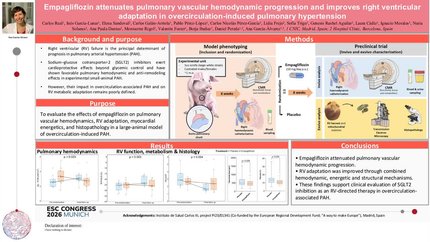
The effect of empagliflozin on right ventricular function in heart failure patients with reduced ejection fraction: analysis from the randomized empire hf clinical trial
European Heart Journal


Abstract
Reverse remodeling of the left ventricle (LV) has been proposed as a key mechanism to the cardio-protective effects of sodium-glucose-transporter-2 (SGLT2) inhibitors in patients with heart failure and reduced ejection fraction (HFrEF). Deterioration of the right ventricular (RV) function is associated with poor outcome, whereas improvement in RV dysfunction has been correlated with improved outcomes in HFrEF patients. The impact of SGLT2 inhibitors on the RV remains unclear.
The aim of this post-hoc study of the Empire HF trial was to investigate the effect of Empagliflozin on RV function assessed by echocardiography in patients with HFrEF after 12 weeks of treatment compared to placebo.
The Empire HF trial was a double-blind, placebo-controlled, randomized clinical trial, in which 190 stable HFrEF patients with a LV ejection fraction (LVEF) ≤40% were randomized (1:1) to receive Empagliflozin 10 mg once daily or matching placebo for 12 weeks. Echocardiographic images were analysed blinded to treatment allocation. Exploratory outcomes were changes in right ventricular function. Statistical analyses were performed using mixed-effects linear models adjusted for age, sex and baseline variables.
Baseline characteristics were well balanced between the two groups; mean age 64 (SD±11) years; males: 85%; mean LVEF 29 (SD±8) %, RV free wall strain (RVFWS): -16.7 (SD±6)%, NYHA-functional class II: 78% and ischemic HFrEF etiology: 51%. No significant between-group differences were detected in RV free wall strain (RVFWS), tricuspid annular plane systolic excursion (TAPSE) or S’ RV free wall (all P>0.05), Figure 1. When stratified into baseline tertiles of RVFWS, patients in the lowest tertile showed a significant improvement in the Empagliflozin group compared to placebo (treatment effect: -4.4 % [95% CI: -8.0 to -0.8]; P=0.018), Figure 2. There was no correlation between the effect of Empagliflozin on RVFWS in the lowest RVFWS tertile and other changes such as LVEF (P=0.845), plasma volume (P=0.710) or weight loss (P=0.639).
In this randomized, short-term trial, Empagliflozin did exert a significant effect on RV function in stable HFrEF patients in the overall study population, but notably improved RVFWS in patients in the lowest tertile of RVFWS at baseline after 12 weeks of treatment. Additional research is required to confirm these explorative findings, and to better understand the impact of SGLT2i on RV function and identify patients who could potentially experience therapeutic and prognostic benefits by RV improvement.
Contributors

You may be interested in