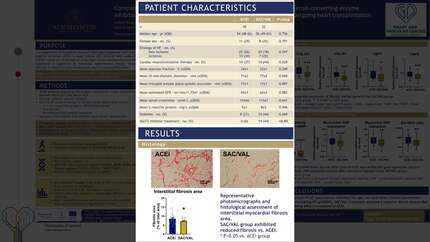
Comparing the anti-remodeling effect of sacubitril/valsartan and angiotensin-converting enzyme inhibition on myocardial samples of advanced heart failure patients undergoing heart transplantation
European Heart Journal


Abstract
In decreasing heart failure (HF) hospitalization and cardiovascular death in HF patients with reduced ejection fraction, Sacubitril/Valsartan (SAC/VAL) treatment was proved to be superior to angiotensin-converting enzyme inhibition (ACEi). According to recent experimental results and clinical data based on echocardiography and circulating biomarkers, this benefit might be at least partially attributed to a greater anti-remodeling effect. However, there is a lack of direct evidence from human myocardial samples for this assumption.
Therefore, we aimed to compare the anti-remodeling effect of SAC/VAL treatment to ACEi on myocardial samples of HF patients undergoing heart transplantation (HTX).
We studied left ventricular (LV) samples of seventy advanced HF patients who underwent HTX and received either SAC/VAL (SAC/VAL group, N=32) or ACEi treatment (ACEi group, N=38) for at least three months prior to HTX. Furthermore, all patients received beta-blockers and mineralocorticoid receptor antagonists titrated to maximally tolerated or target dose. Our groups were matched for age, sex, ejection fraction and other clinical parameters. Patients with liver or kidney failure, mechanical circulatory support, systemic inflammatory/fibrotic diseases or positive inotrope treatment were excluded. Myocardial mRNA expression of fibrotic markers and B-type natriuretic peptide (BNP) were measured with qRT-PCR and normalized to glyceraldehyde 3-phosphate dehydrogenase expression. Interstitial fibrosis area was assessed histologically.
Preoperative plasma N-terminal pro-BNP levels were similar in the two groups (SAC/VAL: 4363±752 pg/mL vs. ACEi: 4616±1020 pg/mL; p=0.911). In contrast, the mRNA level of BNP in the myocardium was lower in patients treated with SAC/VAL (SAC/VAL: 2.2±1.05 vs. ACEi: 5.2±1.74; p=0.006). TIMP metallopeptidase inhibitor 1 (SAC/VAL: 0.07±0.01 vs. ACEi: 0.13±0.02; p=0.011), TIMP metallopeptidase inhibitor 2 (SAC/VAL: 0.06±0.01 vs. ACEi: 0.11±0.01; p<0.001), collagen type I alpha 1 chain (SAC/VAL: 0.02±0.00 vs. ACEi: 0.08±0.02; p<0.001) and collagen type III alpha 1 chain (SAC/VAL: 0.12±0.02 vs. ACEi: 0.27±0.04; p<0.001) relative gene expressions were also decreased in the LV of SAC/VAL-treated patients. Histology analysis confirmed reduced interstitial myocardial fibrosis area in the SAC/VAL group as well (SAC/VAL: 7.2±0.4% vs. ACEi: 8.6±0.5%; p=0.031).
SAC/VAL treatment decreased the myocardial expression of BNP and fibrosis-related genes to a greater extent compared with ACEi in LV samples of patients undergoing HTX. Histological analysis also verified the differences in fibrosis. Thus, the anti-remodeling effect of SAC/VAL might be superior to ACEi even in advanced HF.
Contributors

T Balint
Author
P Kocsis-Balogh
Author
Z Horvath
Author
A Olah
Author
A A Sayour
Author
B A Barta
Author
B Merkely
Author
T Radovits
Author
M Ruppert
Author