Assessment of cardiopulmonary exercise capacity in suspected heart failure with preserved ejection fraction: impact of coronary flow velocity reserve and body fat
European Heart Journal


Abstract
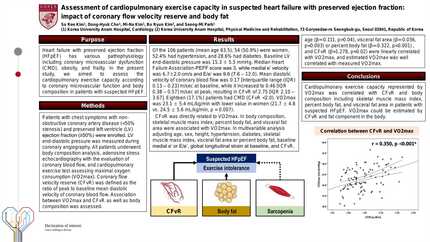
Heart failure with preserved ejection fraction (HFpEF) has various pathophysiology including coronary microvascular dysfunction (CMD), obesity, and frailty. In the present study, we aimed to assess the cardiopulmonary exercise capacity according to coronary microvascular function and body composition in patients with suspected HFpEF.
Patients with chest symptoms with non-obstructive coronary artery disease (<50% stenosis) and preserved left ventricle (LV) ejection fraction (≥50%) were enrolled. LV end-diastolic pressure was measured during coronary angiography. All patients underwent body composition analysis, adenosine stress echocardiography with the evaluation of coronary blood flow, and cardiopulmonary exercise test assessing maximal oxygen consumption (VO2max). Coronary flow velocity reserve (CFvR) was defined as the ratio of peak to baseline mean diastolic velocity of coronary blood flow. Association between VO2max and CFvR as well as body composition was assessed.
Of the 106 patients (mean age 63.5), 54 (50.9%) were women, 52.4% had hypertension, and 28.6% had diabetes. Baseline LV end-diastolic pressure was 15.3 ± 5.5 mmHg. Median Heart Failure Association-PEFF score was 3, while medial e’ velocity was 6.7 ± 2.0 cm/s and E/e’ was 9.6 (7.6 – 12.0). Mean diastolic velocity of coronary blood flow was 0.17 [interquartile range (IQR) 0.13 – 0.23] m/sec at baseline, while it increased to 0.46 [IQR 0.38 – 0.57] m/sec at peak, resulting in CFvR of 2.75 [IQR 2.10 – 3.67]. Eighteen (17.1%) patients had CMD (CFvR <2.0). VO2max was 23.1 ± 5.4 mL/kg/min with lower value in women (21.7 ± 4.8 vs. 24.5 ± 5.6 mL/kg/min, p = 0.007). CFvR was directly related to VO2max (r = 0.350, p <0.001). In body composition, skeletal muscle mass index, percent body fat, and visceral fat area were associated with VO2max. In multivariable analysis, age, visceral fat area or percent body fat, and CFvR were linearly correlated with VO2max, and estimated VO2max was well correlated with measured VO2max.
Cardiopulmonary exercise capacity represented by VO2max was correlated with CFvR and body composition including skeletal muscle mass index, percent body fat, and visceral fat area in patients with suspected HFpEF. VO2max could be estimated by CFvR and fat component in the body.
Contributors


You may be interested in