Dapagliflozin enhances arterial and venous compliance during exercise in heart failure with preserved ejection fraction
European Heart Journal


Abstract
Systemic arterial compliance and venous capacitance are typically impaired in patients with heart failure with preserved ejection fraction (HFpEF), contributing to hemodynamic congestion with stress. Sodium-glucose cotransporter-2 inhibitors (SGLT2i) reduce hemodynamic congestion and improve clinical outcomes in patients with HFpEF, but the mechanisms remain unclear.
This study tested the hypothesis that SGLT2i dapagliflozin would improve systemic arterial compliance and venous capacitance during exercise in patients with HFpEF.
In this secondary analysis from the RCT trial, patients with HFpEF underwent invasive hemodynamic exercise testing at baseline and following treatment for 24 weeks with dapagliflozin or placebo. Patients were required to display pulmonary capillary wedge pressure (PCWP) ≥25 mmHg during exercise at the time of baseline evaluation. Radial artery pressure (BP) was measured continuously using a fluid-filled catheter with transformation to aortic pressure, central hemodynamics were measured using high-fidelity micromanometers, and stressed blood volume was estimated (eSBV) from hemodynamic indices fit to a comprehensive cardiovascular model.
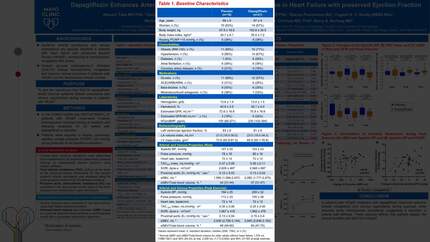
A total of 37 patients completed the study and were included in this analysis (21 dapagliflozin and 16 placebo). Patients were predominantly women (24/37, 65%) and older (mean age 67 years). There was no statistically significant effect of dapagliflozin on resting BP, but dapagliflozin reduced systolic BP during peak exercise (estimated treatment difference [ETD], -18.8 mmHg, 95% CI: -33.9 to -3.7, P=0.016) (Figure 1A). Dapagliflozin improved exertional total arterial compliance (TAC) index (ETD, 0.06 mL/mmHg/m2, 95% CI: 0.003 to 0.11, P=0.039) (Figure 1B) and aortic root characteristic impedance (ETD, -2.6 mmHg/ml*sec, 95% CI: -5.1 to -0.03, P=0.048) during peak exercise, with no significant effect on systemic vascular resistance. Dapagliflozin reduced eSBV at rest and during peak exercise (ETD, -292 mmHg, 95% CI: -530 to -53, P=0.018) (Figure 1C), and improved venous capacitance evidenced by a decline in ratio of eSBV to total blood volume (ETD, -7.3%, 95% CI -13.3 to -1.3, P=0.020). Each of these effects of dapagliflozin during peak exercise were also observed during matched 20W exercise intensity. Improvements in TAC index and eSBV were correlated with decreases in body weight, and reduction in systolic BP with treatment was correlated with the change in eSBV during exercise (r=0.40, P=0.019) (Figure 2A). Decreases in BP were correlated with reduction in PCWP during exercise (r=0.56, P<0.001) (Figure 2B).
In patients with HFpEF, treatment with dapagliflozin improved systemic arterial compliance and venous capacitance during exercise, while reducing aortic characteristic impedance, suggesting a reduction in arterial wall stiffness. These vascular effects may partially explain the clinical benefits with SGLT2i in HFpEF.
Contributors

A Tada
Author
J Naser
Author
T Harada
Author
B Pourmussa
Author
M Jensen
Author
R Carter
Author
J Chirinos
Author

You may be interested in