Significant correlation between the extent of myocardial fibrosis and heart failure parameters in patients undergoing transcatheter aortic valve implantation
European Heart Journal


Abstract
Recent studies have demonstrated that the prognosis of patients undergoing transcatheter aortic valve implantation (TAVI) is determined by the presence of myocardial fibrosis. The aim of this study was to quantify myocardial fibrosis in tissues obtained through myocardial biopsy before TAVI and to evaluate the relationship between the extent of myocardial fibrosis and baseline cardiac parameters.
We performed a retrospective single-center study, including 93 patients who underwent cardiac biopsies before TAVI from December 2022 to December 2023. The extent of myocardial fibrosis was assessed on Masson’s trichrome-stained tissue specimens, using a validated software "ImageJ".
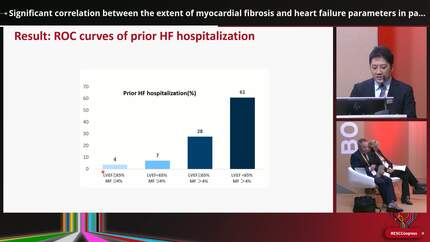
Median percent area of myocardial fibrosis in the entire cohort was 4.7% (interquartile range: 2.5 - 7.9). A significant correlation was found between the extent of myocardial fibrosis and brain natriuretic peptide (r= 0.41 p=0.0001), left ventricular ejection fraction (r=0.34, p=0.0009), aortic valve area index (r=0.33, p=0.0017), and global longitudinal strain (r=0.52, p<0.001). Patients who experienced prior heart failure hospitalization had a significantly larger extent of myocardial fibrosis (3.3% vs. 7.0%, p=0.0002).
Extensive myocardial fibrosis was associated with various heart failure parameters in patients undergoing TAVI. Patients with a large extent of myocardial fibrosis may require early intervention and/or intensive heart failure medical therapy to prevent fibrosis progression.
Contributors

K Yamaguchi
Author
K Matsushita
Author
K Terasaka
Author
Y Hanajima
Author
K Tsustsumi
Author
H Kirigaya
Author
H Nakahashi
Author
M Gohbara
Author
Y Kimura
Author
K Okada
Author
T Ebina
Author
T Cho
Author
K Uchida
Author
A Sugano
Author
K Hibi
Author
You may be interested in