Infection management in the extravascular implantable cardioverter defibrillator: experience from the EV ICD Pivotal study
European Heart Journal


Abstract
The extravascular implantable cardioverter defibrillator (EV ICD) has recently emerged as an option for guideline indicated ICD patients. Results from the EV ICD Pilot and Pivotal studies demonstrated that the device can provide safe and effective therapy through chronic follow up. Lead placement outside the vasculature has the potential to reduce systemic infections. Infection occurrence and management details from the Pivotal are reported.
To report on details of infection occurrence and management from the EV ICD Pivotal study.
The EV ICD Pivotal study was an international, prospective, single-arm, premarket clinical study. Patients with a class I or IIa indication for a single-chamber ICD per ESC or ACC/AHA/HRS guidelines were enrolled.
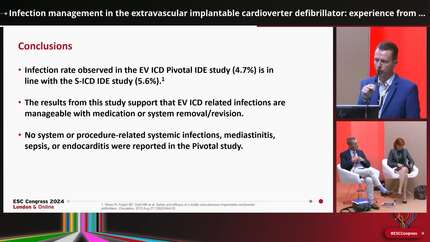
In the EV ICD Pivotal study, 316 patients had an implant attempt, (74.7% male, age 53.8±13.1 years, 82% primary prevention, LVEF of 38.9%±15.4%, and NYHA Class I [23.7%] or II/III [65.5%]), of which 15 had a system or procedure-related infection (4.7%, 9 - 737 days post-implant) through an average 16.2 months follow-up. Of these infections, 8 were classified as major complications, 3 as minor, and 4 as observations. Most (n=9) infections were addressed through medication with or without wound care (2.8% of patients) while 6 (1.9% of patients) resulted in system removal. There was a single lead-related infection addressed through system explant. However, there were no reports of mediastinitis, sepsis, or endocarditis. No system removal resulted in sequelae.
Infection rates observed in the EV ICD Pivotal study were similar to those reported in the subcutaneous implantable cardioverter defibrillator. The results from this study support that EV ICD related infections are treatable with antibiotic therapy or system removal. No system or procedure-related systemic infections such as mediastinitis, sepsis, or endocarditis have been reported in the Pivotal study.
Contributors


I Crozier
Author
F Murgatroyd
Author
L V A Boersma
Author
J Manlucu
Author
B P Knight
Author

U M Birgersdotter-Green
Author
T Mattioni
Author
D Sholevar
Author
A Hersi
Author

You may be interested in