Atrial rates during treated ventricular tachycardia in patients with implantable cardioverter defibrillators: clinical implications of a vagal sinus node response
European Heart Journal


Abstract
Autonomic tone plays an important role in the genesis and sustenance of ventricular tachycardia (VT). Whilst sympathetic hyperactivity is an established driver of ventricular arrhythmias, sinus node response during VT varies broadly between patients, and can be paradoxical.
We hypothesized that device-detected changes in sinus node rate could be an important surrogate of the autonomic response to VT, and may exert significant – and potentially modifiable – haemodynamic consequences independent of ventricular activity.
Device electrograms were analysed from consecutive patients with dual chamber implantable cardioverter defibrillators (ICDs) requiring anti-tachycardia pacing (ATP) or defibrillation for sustained monomorphic VT. Atrial rates were measured before VT onset (‘baseline’) and again at the point of detection by the device. Sinus node response was characterized as ‘stable’ (atrial rate remained within 10% of baseline), ‘sympathetic’ (atrial rate increased >10%) or ‘vagal’ (atrial rate decreased >10%). Patients who did not maintain ventriculoatrial dissociation or who presented in atrial tachyarrhythmia were excluded. Symptoms and electrical response to ICD therapies were recorded.
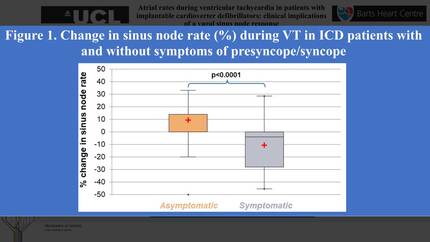
172 treated episodes of VT were included from 97 patients (median age: 69 years, 65% male, 31% ischaemic cardiomyopathy, median ventricular rate: 205bpm, median ejection fraction: 30%). Sinus node response was stable in 55%, sympathetic in 24% and vagal in 21%. A vagal response was associated with ATP-refractory VT (OR: 2.2 (1.1-4.8) p=0.03) and, when adjusting for ventricular rate, was independently associated with symptoms of presyncope or syncope (adjusted OR: 6 (2.7-13.7), p<0.0001).
This preliminary analysis suggests that a vagal sinus node response during VT is associated with adverse outcomes in ICD patients. Vagolytic therapy has recently been demonstrated to improve haemodynamic tolerance during VT ablation; whether supportive atrial pacing during VT could mitigate symptoms and potentiate arrhythmia termination in ICD patients warrants further exploration.
Figure 1: Change in sinus node rate during sustained monomorphic ventricular tachycardia in patients with dual chamber ICDs, stratified by the occurrence of presyncopal symptoms or syncope
Contributors

E Maclean
Author
H Page
Author
T Ganeswaran
Author
Barts Health NHS Trust London , United Kingdom of Great Britain & Northern Ireland
R Lamelas
Author
S Whittaker-Axon
Author
S Martin
Author
St Bartholomew's Hospital London , United Kingdom of Great Britain & Northern Ireland

J Tonko
Author
C Monkhouse
Author
P Lambiase
Author
M Dhinoja
Author
You may be interested in