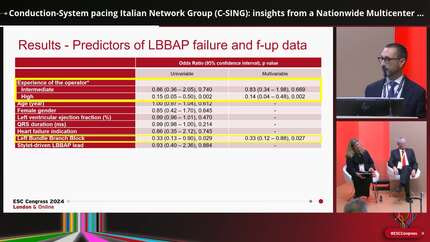
Conduction-System pacing Italian Network Group (C-SING): insights from a Nationwide Multicenter Observational Study
European Heart Journal


Abstract
Conduction system pacing (CSP), encompassing His bundle pacing (HBP) and left bundle branch area pacing (LBBAP), has gained prominence in treating bradycardia and heart failure in recent years. Despite its increasing utilization, data on real-world adoption of CSP are limited.
The C-SING study aimed at assessing patient characteristics, implant success, procedural details, and safety of CSP when performed in routine clinical practice.
Periprocedural data from 27 experienced CSP centers across Italy were collected on patients undergoing CSP implantation for various indications between January 2021 and January 2024.
The study comprised 1,317 patients (median age 78 years [interquartile range, 71-83], male 66.2%). Leading indications included atrioventricular (AV) block (40.8%), sinus node dysfunction (12.1%), atrial fibrillation with bradycardia (9.7%), AV node ablation (9.5%), and heart failure (12.5%). Pacemakers were implanted in 77.3% of patients, cardiac resynchronization devices in 21.7%, and implantable cardioverter-defibrillators in 1.0%. Stylet-driven and lumenless CSP leads were utilized in 64.7% and 35.3% of procedures, respectively. Final 12-lead ECG assessment revealed LBBAP capture in 88.7% patients, HBP in 8.4% (selective 4.2%, non-selective 4.2%), and no CSP capture in 3.0%, resulting in a 97.0% CSP lead implantation success rate. In patients with LBBAP, predominant capture types were left bundle branch pacing (19.6%), left posterior fascicular pacing (19.2%), and left septal fascicular pacing (14.8%).
Comparing HBP to LBBAP, the latter showed shorter procedural time (60 minutes [45-80] vs. 70 minutes [60-95], p=0.003), but similar fluoroscopy time (6.0 minutes [3.3-10.8] vs. 6.1 minutes [4-10], p=0.735). Paced QRS duration was longer in LBBAP (118 ms [105-130]) compared to HBP (110 ms [101-122], p<0.001). LBBAP showed lower capture thresholds (0.6 V [0.5-0.9] @0.4 ms vs. 0.8 V [0.5-1.5] @1.0 ms, p<0.001) and higher R-wave sensing (10.7 mV [8-16] vs. 4.5 mV [2.4-9.9], p<0.001).
The rate of periprocedural complications was higher in patients with LBBAP than HBP (7.3% vs. 1.8%, p=0.03), with the most frequent events being intraprocedural perforation into the left ventricular cavity during lead screwing (2.6%) and CSP lead dislodgment before hospital discharge (1.4%). These occurrences necessitated lead repositioning without additional complications.
CSP demonstrated feasibility as a primary pacing strategy for various indications in a real-world, multicenter setting. LBBAP, more frequently used than HBP, exhibited shorter procedural time and superior acute electrical parameters. LBBAP revealed a higher rate of minor procedural complications than HBP. Further investigations, supported by additional long-term outcome data, are essential to comprehensively assess CSP performance.
Contributors


P Palmisano
Author
M Bertini
Author
M Magnano
Author
M Volpicelli
Author
M Baroni
Author
U Startari
Author
P Donateo
Author
A Paoletti Perini
Author
L De Mattia
Author
G Rovaris
Author
L Tomasi
Author
L Poggio
Author
A Rapacciuolo
Author
G Patti
Author
You may be interested in