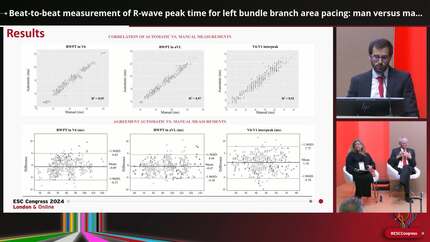
Beat-to-beat measurement of R-wave peak time for left bundle branch area pacing: man versus machine using a novel automated algorithm
European Heart Journal


Abstract
Assessment of stimulation spike to R-wave peak time (RWPT) in V6 and in aVL, and V6-V1 interpreak interval, may be used to evaluate presence of conduction system capture during left bundle branch area pacing (LBBAP). This is performed by manual measurements which is tedious and requires a skilled operator to limit variability in the measurements. Automatic beat-to-beat measurement of these intervals may streamline workflow during implantation, but such an algorithm has never been tested so far.
To test the feasibility of performing beat-to-beat automatic measurement of RWPT using an algorithm designed to measure the interval between the stimulation spike and the peak positive voltage, and to compare the results with manual measurements.
ECG recordings from 50 patients (28% female, mean age 81.5 ± 9.0 years) undergoing LBBAP implantation were evaluated on a electrophysiology recording system by manually measuring RWPT in V6 and in aVL and the V6-V1 interpeak intervals . A single operator performed offline measurements on 10 consecutive beats in each patient. The same beats were subjected to the same measurements using an automatic algorithm after signal conditioning in a novel EP recording System. The correlation between manual and automatic measurements was calculated. Variability of the measurements (evaluated by standard deviation) in the 10 consecutive beats was also compared.
Of the 500 beats measured, 3 were excluded due to obvious morphological differences affecting the interval measurement (e.g. due to fusion beats). The algorithm was unable to make a measurement in V6 in 20 beats and manual assessment of aVL was not possible in one patient, meaning that 1461/1500 (97.4%) measurements were compared between the manual and automatic methods. The results are shown in the figure. There was excellent correlation between manual and automatic measurements, with lower variability using the latter method.
Beat-to-beat automatic measurement of RWPT is feasible and provides excellent correlation with manual measurements, with less variability in the values. This algorithm may streamline the measurements during implantation. However, prospective evaluation is required to confirm operation of the algorithm in the clinical setting to include challenges such as electrical noise.


You may be interested in