Stereotactic arrhythmia radioablation - A systematic review and meta-analysis of the prospective clinical studies
European Heart Journal


Abstract
Stereotactic arrhythmia radioablation (STAR) is increasingly being evaluated in prospective studies as a new promising treatment option for patients with therapy-refractory ventricular tachycardia (VT). In STAR, the VT substrate is noninvasively treated with a high dose of radiotherapy. Recently, several single-arm prospective studies evaluating the clinical outcomes of STAR were published. Considering that the evidence base consists mainly of retrospective case series, we conducted a systematic review and meta-analysis to synthesize the prospective data on outcomes of STAR.
To perform a systematic review and meta-analysis of prospective studies evaluating clinical outcomes of STAR for VT.
This study was registered in PROSPERO and adhered to the PRISMA reporting guidelines. Full-text studies describing prospective studies evaluating the safety and efficacy of STAR for VT were included in this study. Records published until August 2023 were retrieved from OVID MEDLINE, OVID Embase, Web of Science Core Collection, the Cochrane Central Register of Controlled Trials, and Google Scholar search engine (top 200 hits), deduplicated, and screened for eligibility. Abstract screening, full-text screening, data extraction and quality assessment were performed by two reviewers independently. Endpoints were defined as treatment related CTCAE grade ≥3 adverse events within 90 days after treatment, overall survival (OS), time to VT recurrence, and recurrence-free survival. Rates of patients achieving pre-defined 50%, 75% and 95% VT burden reduction thresholds were summarised. Random-effects generalized linear mixed-effects models and inverse variance models were used for the meta-analysis.
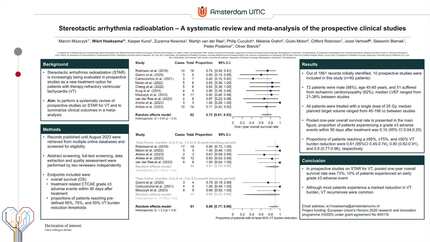
1861 records were identified, 987 were screened, and 10 full-text manuscripts published between 2019 and 2023 describing the results of STAR in 82 patients were included in this study. The majority were male (n=72; 88%), between 45 and 85 years old, and suffered from ischaemic cardiomyopathy (n=51; 62%). Median left ventricular ejection fraction ranged from 21 to 38% between studies. 20 patients did not undergo a prior catheter ablation for VT. All patients were treated with a single dose of 25 Gy and median planned target volume ranged from 45 to 198 cc between studies. Pooled 12-month OS rate was 0.73, and the proportion of patients experiencing grade ≥3 adverse events within 90 days after STAR was 0.11 (Figure 1). Reduction in VT burden is shown in Table 1. Although these were not pooled because of large heterogeneity in VT reduction time frame definitions, it can be appreciated that most of the patients experienced a reduction in VT burden.
The increasing evidence from prospective studies on STAR shows acceptable 12-month OS in a population of patients with advanced heart failure and refractory VT. Moreover, there is a modest rate of high-grade adverse events and most patients experience a reduction in VT burden.
Forest plots OS and adverse events
VT burden reduction per study
Contributors

M Miszczyk
Author
K Kuna
Author
Z Nowicka
Author
M H Van Der Ree
Author
P S Cuculich
Author
M Grehn
Author
G Molon
Author
C G Robinson
Author
J J C Verhoeff
Author
S Blamek
Author
P G Postema
Author
O Blanck
Author
You may be interested in