The relative importance of ischaemia and scar in the genesis of ventricular arrhythmia in ischaemic cardiomyopathy
European Heart Journal


Abstract
Ventricular arrhythmias are a leading cause of death in patients with ischaemic cardiomyopathy (ICM). Ischaemia and scar are thought to contribute to arrhythmogenesis; as scar is considered fixed, strategies to reduce ischaemia such as revascularisation are undertaken to attempt to reduce risk, despite limited evidence behind this practice.
The study rationale was to understand the relative contributions of ischaemia and scar on the genesis of arrhythmia in an ICM population, by undertaking a detailed assessment of arrhythmic substrate in a highly characterised population and secondly by validating these findings in a large cohort.
We assessed the relationship between scar, ischaemic burden and impact of ischaemia modulation via revascularisation on the arrhythmic substrate (study 1) and major arrhythmic events (study 2).
S1: Patients were eligible for enrolment if they had an LVEF≤40%, extensive coronary disease (BCIS Jeopardy Score (JS) ≥6) and were due to undergo CABG or PCI. Arrhythmic substrate was characterised by the LV activation recovery interval (ARI) dispersion recorded by electrocardiographic imaging (ECGi). Scar and ischaemic burden were assessed via stress perfusion cardiac magnetic resonance (pCMR) imaging, calculated as a percentage of total LV myocardial volume. ECGi and pCMR were repeated 3 months post revasc.
S2: Arrhythmia data were collected from device interrogation reports and blinded core lab analyses performed of CMR scans and angiograms of patients enrolled in the REVIVED-BCIS2 trial. Extent of revasc (quantified by change in JS/baseline JS) was used to estimate change in ischaemic burden. The primary outcome was death or aborted sudden death.
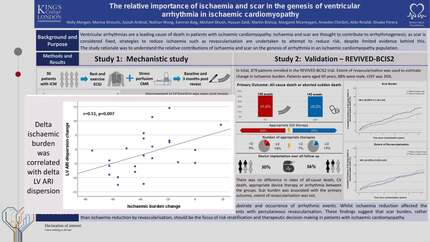
S1: 30 patients were recruited; age 67±10 years, 87% male, BMI 28±5. Baseline LV ARI dispersion at rest was correlated with scar burden (r=0.37, p=0.04) but not ischaemic burden (r=0.25,p=0.21). Changes in metrics are shown(Table 1). Ischaemic burden reduced after revascularisation. Delta ischaemic burden was correlated with delta LV ARI dispersion (r=0.51, p=0.007 unadjusted).
S2: Data was collected on 479 patients from REVIVED-BCI2 who underwent CMR; age 69±9 yrs, 88% male, BMI 28±6, LVEF 26±8%. 237 were randomised to PCI and 242 to OMT; no difference in rates of all-cause death, CV death, aborted sudden death, appropriate device therapy or arrhythmia was identified between the groups. Scar burden was associated with death or aborted sudden death, extent of revascularisation was not(Figure 1).
In our studies, the volume of scar was strongly related to both the arrhythmic substrate and occurrence of arrhythmic events. Whilst ischaemia reduction affected the arrhythmic substrate, this did not translate to a reduction in clinical events. These findings suggest that scar burden, rather than ischaemia reduction by revascularisation, should be the focus of risk stratification and therapeutic decision making in patients with ICM.
Contributors


A Ardinal
Author
N Wong
Author
K Baig
Author
M Ghosh
Author

M Mcentegart
Author

A Chiribiri
Author
St Thomas' Hospital and King's College London London , United Kingdom of Great Britain & Northern Ireland
C A Rinaldi
Author

You may be interested in