Impact of the underlying rhythm during cavotricuspid isthmus ablation on the incidence of future new-onset atrial fibrillation: insights from an international multi-centre registry
European Heart Journal


Abstract
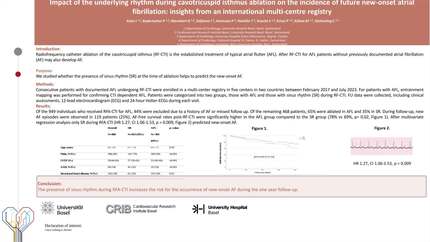
Radiofrequency catheter ablation of the cavotricuspid isthmus (RF-CTI) is the estabslished treatment of typical atrial flutter (AFL). After RF-CTI for AFL patients without previously documented atrial fibrillation (AF) may also develop AF. It is unknown whether the presence or absence of AFL at the time of ablation can predict the future occurence of AF.
To compare baseline characteristics, procedural data, and long-term follow-up (FU) of patients with AFL.
Consecutive patients with documented AFL undergoing RF-CTI were enrolled in a multi-center registry in five centers in two countries between February 2017 and July 2023. For patients with AFL, entrainment mapping was performed for confirming CTI dependent AFL. Patients were categorized into two groups, those with AFL and those with sinus rhythm (SR) during RF-CTI. FU data were collected, including clinical assessments, 12-lead electrocardiogram (ECG) and 24-hour Holter-ECGs during each visit.
Of the 949 subjects, 36% were excluded from the analysis due to a history of AF. A total of 574 patients were included (mean age 68 +/- 11 yrs, 14% females), 62% presented in AFL group and 38 % SR group during CTI. Median FU was 364 days. Patients in AFL group were older (P < 0.029), more likely to have diabetes (P = 0.026), and were less frequently treated with antiarrhythmic drugs (P < 0.001). In the first 12 months of FU, 40% of the patients underwent three FU examinations, while 77% of the patients underwent at least one 24-hour Holter-ECGs during FU. In the Kaplan-Meier analysis patients in AFL group significantly less often developed AF during FU (log-rank, P < 0.016, central ). In the multivariate Cox regression analysis, sinus rhythm during ablation (hazard ratio 1.474; 95% CI 1.043-2.084; P = 0.028), male gender (hazard ratio 1.722; 95% CI 1.116-2.658; P = 0.014) and coronary artery disease (hazard ratio 1.711; 95% CI 1.145-2.555; P = 0.009) were identified as predictors for the occurence of AF during FU.
Over a one year follow-up, new onset AF occurs significantly less frequently in patients with ongoing atrial flutter during RF-CTI ablation.
Contributors

P Badertscher
Author
D Mannhart
Author
I Zeljkovic
Author
N Pavlovic
Author
P Ammann
Author
T Reichlin
Author
L Roten
Author
D Spreen
Author
S Knecht
Author
P Krisai
Author
M Kuehne
Author
C Sticherling
Author
You may be interested in