The efficacy and safety of NOAC in very elderly atrial fibrillation patients; data from the Korean national health insurance cohort registry
European Heart Journal


Abstract
Data regarding efficacy and safety on anticoagulation in very elderly atrial fibrillation patients are relatively sparse.
We investigated the clinical benefit of anticoagulation with NOAC in very elderly AF patients through national healthcare insurance registry.
Clinical data of 862,935 patients who were diagnosed with AF from 2015 to 2020 were collected for analysis. Patients under the age of 85, prior history of ICH, GI bleeding and prior prescription days of aspirin, warfarin and NOAC exceeding 90 along with follow up period less than 90 days were excluded.
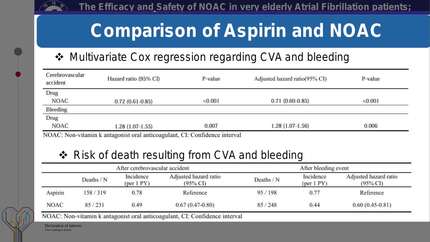
A total of 10,625 patients were eligible for analysis. Patients with OAC (HR: 0.60, 95% CI 0.53-0.69), p<0.001) showed higher efficacy regarding systemic embolism compared to aspirin (HR: 0.84, 95% CI 0.74-0.95, p=0.008) and no treatment group. Individual comparison of NOAC and aspirin via propensity score matching showed that patients with NOAC (HR: 0.71, 95% CI 0.61-0.85), p<0.001) showed higher event free survival regarding systemic embolism compared to aspirin. Bleeding risk was also higher for NOAC (HR: 1.28, 95% CI 1.07-1.56, p=0.006) group but did not result in commensurate increase in mortality (HR:0.60, 95% CI 0.45-0.81, p<0.001).
Anticoagulation with NOAC in very elderly patient showed higher event free survival regarding systemic embolism. Despite having higher event rate of bleeding, eventual death did not show any association with NOAC.


You may be interested in