improvement of left atrial function after ablation in patients with paroxysmal atrial fibrillation is associated with the presence of heart failure with preserved ejection fraction
European Heart Journal


Abstract
Atrial fibrillation (AF) and heart failure with preserved ejection fraction (HFpEF) often coexist and left atrial (LA) function was impaired in both AF and HFpEF. However, It remains unclear if HFpEF is linked to LA function improvement in paroxysmal atrial fibrillation (pxAF) patients post-ablation.
To investigate whether the improvement of LA function after ablation in patients with pxAF combined with HFpEF is better than that in patients without HFpEF.
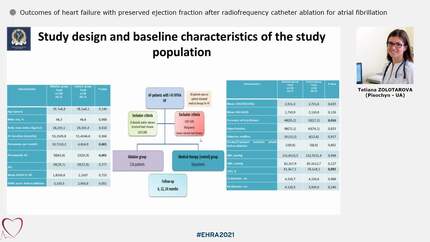
147 patients with pxAF were enrolled and HFpEF was ascertained based on the H2FPEF score. All patients underwent transthoracic echocardiography (TTE) at baseline and 3 months after ablation. Left atrial volume index (LAVI), left atrial ejection fraction (LAEF) and left atrial peak reservoir strain (LA RS) were measured. Improvement of left atrial function is defined as the difference in the above 3 indicators at baseline and 3 months after ablation. The change of the above atrial functional parameters was compared between patients with high-probability of HFpEF [hp-HFpEF] and medium/low-probability of HFpEF [lp-HFpEF]) in univariate and multivariate analysis. Statistical analyses were conducted using independent samples t-tests, Mann-Whitney U tests, and ANCOVA.
147 patients were included (30 hp-HFpEF, 117 lp-HFpEF, mean age 62.6 years, 63.3% men, mean BMI 25.54kg/㎡, mean disease course 28.2 months, mean CHA2DS2-VASc score 1.97). In the univariate analysis, the following factors were significantly different between hp-HFpEF and lp-HFpEF, including BMI (26.95±3.71 vs. 25.18±3.00, p=0.007), CHA2DS2-VASc score (3[3-4] vs. 2[1-2], p<0.001), LA function at baseline including LAVI (41.59±11.38 vs. 32.57[27.68-41.10], p=0.003), LAEF (45.97±10.26 vs. 57.23±9.08, p<0.001), LA RS (26.43±10.68 vs. 34.43±10.60, p<0.001), and difference at baseline and 3 months after ablation in LA function including LAVI (4.92±1.08 vs. 3.33±1.18, p<0.001), LAEF (13.41±9.71 vs. 2.98±9.69, p<0.001), LA RS (23.61±10.23 vs. 7.29±6.91, p<0.001), and in left ventricular (LV) TTE indicators including E/e’ (3.10±2.30 vs. -0.32±2.68, p<0.001), LV ejection fraction (10.5[7.0-16.5] vs. 2.0[-5.0-6.0], p<0.001), LV global longitudinal strain (14.94±4.27 vs. 5.15[2.63-8.30], p<0.001) and LV mass (17.79±28.67 vs 1.50[-8.75-17.00], p=0.006).
After adjusted for BMI, CHA2DS2-VASc score, LA function at baseline and difference at baseline and 3 months after ablation in LV TTE indicators, the improvement of LA function 3 months after ablation in patients with hp-HFpEF is better than that in patients with lp-HFpEF: LAVI significantly decreased (4.24±0.21 vs. 3.46± 0.09, p<0.001), LAEF significantly increased (12.90±2.13 vs. 3.09±0.86, p<0.001) and LA RS significantly increased (21.44±1.81 vs. 8.02±0.76, p<0.001) in hp-HFpEF compared with lp-HFpEF.
Patients with pxAF with hp-HFpEF showed better improvement in LA function after ablation than those with Ip-HFpEF.

You may be interested in