Risk and causes of hospital admission in patients with atrial fibrillation on treatment with oral anticoagulants
European Heart Journal


Abstract
Atrial fibrillation (AF) is associated with an increased risk of hospitalisation, although the main reasons for hospital admission and the role of antiarrhythmic drugs are not clarified.
The aim of our study was to assess the incidence rate and the factors associated with all-cause, cardiovascular and AF-related causes of hospitalisation in patients suffering from AF.
This is a prospective single-centre ongoing study (ATHERO-AF cohort) which included 2782 patients affected by non-valvular AF on oral anticoagulants. The primary endpoints were all-cause, cardiovascular and AF-related hospitalisation. Cardiac hospitalizations were defined as (non-AF) arrhythmias, acute coronary syndromes, heart failure (HF), systemic embolism, hypertensive urgency, vascular/cardiac surgery. The AF-related hospitalisation was defined as a recurrence of AF in paroxysmal pattern or as a high-rate symptomatic AF episode in persistent/permanent patterns. Multivariable Cox proportional hazards regression analysis was used to calculate the hazard ratio (HR) with 95% Confidence interval (95%CI) for each factor in relation to risk of hospitalisation.
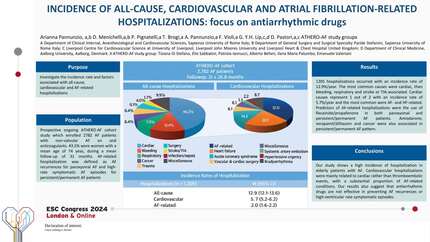
Overall, 43.5% of patients were women with a mean age of 74.6±9.1year. Patients were followed for a mean of 31±26.8 months. We registered 1205 (12.1%/year) hospitalisations for any reason, 533 (5.7%/year) for cardiovascular causes and 180 (2.0%/year) were AF-related hospitalisations (Central illustration). Among the anti-arrhythmic drug use, we highlighted that flecainide and propafenone were associated with AF-related hospitalisations in paroxysmal and in persistent/permanent patterns (HR 1.861, 95%CI 1.116-3.101 and HR 1.947, 95%CI 1.069-3.548, respectively). Amiodarone (HR 3.012, 95%CI 1.835-4.943) and verapamil or diltiazem (HR 2.067, 95%CI 1.117-3.825) were associated with an increased risk of AF-related hospitalisations in persistent/permanent AF pattern. Furthermore, cancer was associated (HR 1.802, 95%CI 1.057-3.070) with increased risk of hospitalisation due to AF-related causes. Conversely, beta-blockers and digoxin were not associated with increased risk of hospital admission.
Hospitalisations of patients with AF are frequent for both cardiovascular and non-cardiovascular causes. Among the AF-related ones, the use of antiarrhythmic drugs emerged as associated with increased risk of hospitalisations, hypothesizing their poor effect in preventing AF episodes. For these reasons, we suggest carefully considering their use, reserving them for symptomatic patients with frequent AF recurrences. Central Illustration
Contributors



You may be interested in