How much does elective cardioversion increase the risk of ischaemic stroke compared to the baseline risk in atrial fibrillation? A nationwide study
European Heart Journal


Abstract
Patients with atrial fibrillation (AF) undergoing cardioversion (CV) are exposed to an increased risk for stroke during the post-cardioversion period, but the exact magnitude of this risk after elective CV with preceding appropriate oral anticoagulant (OAC) therapy is unknown.
We explored the rate of ischaemic stroke (IS) after elective CV and compared the IS rate during the post-cardioversion period with the long-term stroke rate in patients with AF using guideline-recommended OAC therapy.
This is a nationwide register-based study, including all AF patients undergoing their first-ever elective CV between 2012-18 in Finland. Data were collected from the Finnish health care registers covering uniquely all levels of care. Visual assessment of the survival curve identified a cut-off point in IS rate at 1 week after CV. Therefore, the follow-up time was split into two intervals, the 1-week post-cardioversion period and the subsequent period up to 360 days. Stroke rates were calculated separately for these periods. Unadjusted and adjusted incidence rate ratios were estimated with Poisson regression. Moreover, interaction between the two follow-up periods and conventional IS risk factors as well as OAC treatment was assessed.
A total of 9625 AF patients undergoing their first elective CV were identified (mean age 67.7±9.9 years, 61.2% men, mean CHA2DS2-VASc score 2.6±1.6). Warfarin was used in 6 245 (64.9%) and non-vitamin K oral anticoagulants in 3 380 (35.1%) patients. Overall, 92 (1.0%) patients suffered an IS during the year after CV. The survival plot displayed a higher incidence of IS within the first week after CV, stabilizing thereafter to a consistent level (Figure). In the adjusted regression analyses, IS rate within the first week after elective CV was 13.6-fold (95% confidence interval [CI]: 8.6-21.5) compared the subsequent rate of IS (Table). We observed no significant interaction between any of the conventional IS risk factors or OAC treatment and the two follow-up time periods, indicating that their association with IS rate did not differ during the post-cardioversion period compared to the subsequent time period.
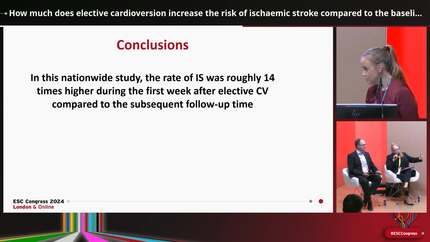
In this nationwide study, the rate of IS was roughly 14 times higher during the first week after elective CV compared to the subsequent follow-up time. Cumulative risk of IS after elective CV Incidence rates of IS after elective CV



You may be interested in