Left atrial enlargement: a crucial indicator for identifying atrial fibrillation in patients with hypertension
European Heart Journal


Abstract
Left atrial enlargement resulting from hypertension is closely linked to the development and persistence of atrial fibrillation (AF). The newly proposed staging recognizes AF as disease continuum, which makes us aware that AF prevention should focus on the Pre-AF stage, and atrial enlargement is one of the important manifestations in this stage. Previous scoring systems, such as CHA2DS2-VASc and C2HEST, along with the recently highlighted left atrial diameter (LAD), have been significant tools for predicting AF occurrence. However, a comprehensive assessment of their utility is currently lacking.
This study aims to explore the role of left atrial size in identifying atrial fibrillation (AF) among hospitalized hypertensives, and to compare its recognition effectiveness with previous scoring systems.
We conducted a cross-sectional analysis within hospitalized hypertensives. The discovery, internal and external validation datasets were established. The XGBoost was employed to identify key variables related to AF occurrence, which were ranked based on their importance scores. To gauge the predictive prowess of LAD regarding AF occurrence, we plotted the receiver operating characteristic curve (ROC) and calculated the area under the curve (AUC). This enabled us to pinpoint the LAD cutoff value corresponding to the maximum Youden index, indicative of susceptibility to AF. Subsequently, Youden index determined the optimal cutoff value from the ROC curve. Delong’s test compared the identification abilities of different tools within the same dataset. Logistic regression analysis assessed the correlation between clinical variables and left atrial size.
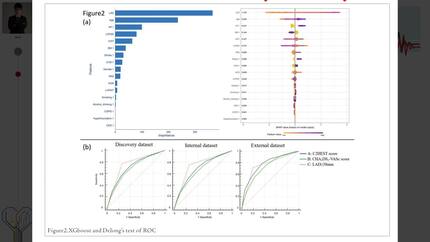
The XGBoost revealed 17 variables affecting AF occurrence in hypertensives, with LAD, age, and HF ranking among the top 3 (Figure 2a). LAD had a more pronounced impact on AF occurrence than other variables. LAD-based identification of AF in hypertensives had AUC of 0.827 (95%CI: 0.816-0.837), with an optimal cutoff of 38mm. Subgrouping the study population by LAD≥38mm, ROC curves showed AUCs of 0.757 (95%CI: 0.745-0.768) for the discovery set, 0.750 (95%CI: 0.731-0.768) for internal validation, and 0.759 (95%CI: 0.743-0.776) for external validation. LAD≥38mm had a more higher and stable AUC value for judging the AF occurrence than CHA2DS2-VASc and C2HEST scores (Figure 2b). Hypertensives with LAD≥38mm had a 9.72-fold higher AF risk than those with LAD<38mm.
LAD is a pivot determinant for AF occurrence. LAD≥38mm is a valuable identifier for high-risk hypertensives prone to AF. Center illustration XGboost and Delong’s test of ROC


You may be interested in