Proteinuria and the risk of incident atrial fibrillation according to diabetes stage in patients with diabetes: a nationwide population-based cohort study
European Heart Journal


Abstract
Proteinuria and diabetes mellitus (DM) are established cardiovascular risk factors, both independently associated with an increased risk of atrial fibrillation (AF). Despite previous findings correlating proteinuria amount with incident AF, regardless of DM diagnosis, the nuanced association at different stages of DM warrants further investigation.
This study aimed to delve into and compare the relationship between proteinuria amount and the risk of incident AF in patients across various stages of DM.
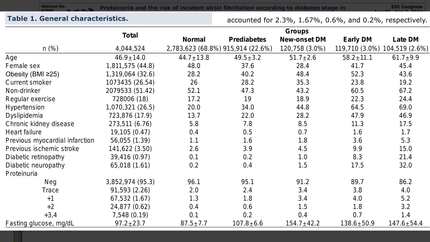
A cohort of 3,866,428 individuals without prior AF and type 1 DM, who underwent the 2009 health checkup provided by the National Health Insurance Service in Korea, were categorized into five DM stages: normal, prediabetes, new-onset DM, early DM (diagnosed < 5 years), and late DM (diagnosed ≥ 5 years). Proteinuria was graded using the urine dipstick test, ranging from negative to 3+ or more. AF incidence was tracked until December 31, 2020.
The cohort, with an average age of 47.0 ± 13.9 years and 45.4% females, demonstrated escalating annual AF incidence rates from 1.90 to 6.45 per 1000 person-years across DM stages (p<0.001) (Figure). Similarly, the rates increased from 2.28 to 7.28 per 1000 person-years by proteinuria levels (p<0.001) (Figure). Adjusted Cox regression models revealed a heightened risk of incident AF associated with higher proteinuria amounts in all DM stages (adjusted hazard ratios for urine dipstick 3+ or more: 1.57, 1.76, 1.44, 2.32, and 2.23, respectively). Notably, the association between proteinuria and incident AF was more pronounced in individuals with early and late DM compared to those with prediabetes and new-onset DM (Figure).
At each DM stage, from prediabetes to late DM, a higher level of proteinuria corresponds to an increased risk of AF development. Furthermore, a stronger association was observed in patients with longer DM duration compared to those with prediabetes or new-onset DM. These findings underscore the significance of monitoring proteinuria levels across DM stages to assess AF risk comprehensively.

You may be interested in