Inflammation and long-term outcomes after first-time direct current cardioversion for atrial fibrillation: a nationwide register study
European Heart Journal


Abstract
Emerging evidence suggests that the pathogenesis of atrial fibrillation (AF) is affected by inflammatory processes which contribute to structural and electrical remodeling of the atria, creating a substrate for arrythmia.
To assess whether inflammation measured by C-reactive protein (CRP) is associated with readmission for direct current (DC) cardioversion, ablation, heart failure or stroke after discharge from 1st time DC cardioversion.
This nationwide retrospective cohort study included patients undergoing 1st DC cardioversion between 2011 and 2018. Exclusion criteria were death within one day of cardioversion and no available CRP at baseline. Primary outcome was readmission for DC cardioversion of AF. Secondary outcomes were AF ablation, new admission of stroke, new admission of heart failure (HF), and all-cause death.
Absolute risk rates (ARR) of outcomes were calculated for patients with available 1-year follow-up data. CRP 20 mg/L was chosen as cutoff to establish a clinically relevant borderline for inflammation.
The association between baseline CRP and outcome was assessed in Cox proportional hazards regression models with a follow-up period starting from 1st DC cardioversion, ending no later than 31st of December 2018, for the entire study population (n=9,977).
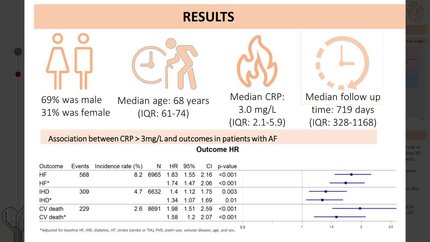
After exclusion criteria the study population consisted of 9,977 patients Mean age for CRP > 20mg/L: 66.8 (IQR: 60.5-74.2). Mean age for CRP < 20mg/L 68.9 (IQR: 62.9-75.9)(p<0.001). In total, 68.9% were male and the most frequent comorbidities included hypertension (57.3%), ischemic heart disease (25.1%), HF (20.6%), and history of stroke (7.1%).
Patients with available CRP measurement and 1yr follow up was 7,764. Compared to patients with low CRP (<20 mg/L), patients with elevated CRP (>20mg/L) had a higher 1-year ARR of HF, and all cause death (p<0.001). Compared to patients with low CRP, patients with elevated CRP had a lower 1-year ARR of all-ablation and new DC cardioversion (p<0.001), (Table 1).
CRP > 20mg/L was associated with lower risk for new DC cardioversion (HR 0.72, 95% CI: 0.64-0.82, p<0.001). However, in patients <75 years of age with CRP > 20mg/L at baseline had an increased risk of stroke after multivariable adjustments (HR 1.92, 95% CI: 1.10-3.35; p = 0.02) (Fig.1), while CRP > 20 mg/L was not associated with an increased risk of stroke in patients > 75yrs of age (Cox regressions estimates) (p for interaction = 0.03).
However, elevated CRP was associated with an increased risk of stroke in patients <75 years of age, even after multivariable adjustments. These results suggest that CRP may not be a reliable predictor of readmission for DC-cardioversion, especially in older individuals, but might be a potential risk stratification tool in identifying AF patients at higher risk of stroke in young individuals. We suspect this is due to the population with elevated CRP has more comorbidities and are older.
Contributors

D Modin
Author
N D Johansen
Author
M F Dons
Author
K G Skaarup
Author
M Sengelov
Author
G Gislason
Author
J B Olesen
Author
M L Hansen
Author
F D Wisborg
Author
J D Hove
Author
T B Lindhardt
Author
U Davidsen
Author
C Ernst
Author
T Biering-Sorensen
Author
You may be interested in