Association between preprocedural thromboembolic or bleeding events under oral anticoagulation therapy and mid-term outcomes after percutaneous left atrial appendage closure
European Heart Journal


Abstract
Currently, no consensus has been established on the most effective antithrombotic therapy to prevent thromboembolic and bleeding events in patients undergoing percutaneous left atrial appendage closure (LAAC).
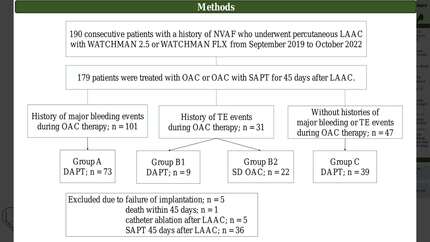
We retrospectively investigated the incidence of device-related thrombosis (DRT), thromboembolic events, and bleeding events in patients who underwent LAAC from September 2019 to October 2022. After categorizing patients into groups based on preprocedural thromboembolic or bleeding events under oral anticoagulation (OAC) therapy, we compared the incidence of DRT and prognosis according to the postprocedural antithrombotic therapy.
In patients who received the conventional antithrombotic therapy (OAC with and without single antiplatelet therapy for 45 days after LAAC and dual-antiplatelet therapy from 45 days to 6 months followed by single antiplatelet therapy), preprocedural thromboembolic events despite OAC were independently associated with DRT or postprocedural thromboembolic events at the 3-year follow-up (hazard ratio [HR] 4.55; 95% confidence interval [CI] 1.32–15.6; P = 0.016), whereas preprocedural bleeding events were independently associated with postprocedural bleeding events (HR 8.01, 95% CI 1.45–58.3; P = 0.036). Continuation of OAC for 12 months among patients who developed preprocedural thromboembolic events during OAC significantly decreased the incidence of DRT or postoperative thromboembolic events (P = 0.002) with no increase in the bleeding events (P = 0.522).
Preprocedural thromboembolic and bleeding events can predict adverse events after LAAC with conventional antiplatelet-based antithrombotic therapy. Patients who develop thromboembolic events under continuous OAC may benefit from continuous OAC for 1 year after LAAC.
Contributors

M Fujita
Author
N Nishiura
Author
K Mushiake
Author
R Chatani
Author
S Ono
Author
H Tasaka
Author
T Maruo
Author
K Kadota
Author
S Kubo
Author
You may be interested in