Significant reduction of complications applying an optimized vascular access and post-interventional groin-site management during electrophysiology procedures
European Heart Journal


Abstract
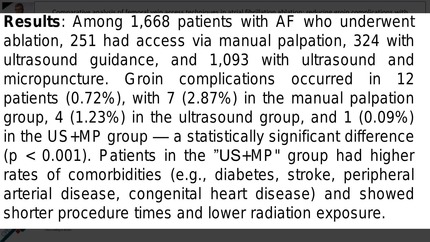
Catheter ablation of cardiac arrhythmias is an established treatment strategy. However, the optimal femoral vascular access strategy and post-interventional management in the electrophysiology (EP) setting is still under debate.
To assess the impact of ultrasound-guided versus conventional femoral vascular puncture and of a modified post-interventional groin-site management strategy on complication rates.
Patients undergoing EP procedures at the our university heart and vascular center are included in an institutional prospective registry. Conventional vascular access as well as post-interventional groin site pressure-bandage and bed rest of 6 hours (group I) was compared to a new strategy including ultrasound-guided vascular access, venous closure by a Z-suture and groin site pressure-bandage for only 2 hours plus additional 4 hours bed rest (group II). Incidences of minor and major groin site complications for both groups were compared. Hematoma, bleeding, arteriovenous fistula or pseudoaneurysm of the femoral artery without need for intervention (e.g. transfusion, thrombin injection, surgery) were classified as minor complications. Complications requiring intervention or retroperitoneal hematoma were defined as major complications.
A total of 1535 procedures in 1381 patients (779 (51 %) procedures in 705 (51%) patients in group I and 756 (49%) procedures in 676 (49%) patients in group II) were analyzed. In group I and group II, respectively, 39%/44% procedures were index pulmonary vein isolations, 30%/29% repeat atrial fibrillation, 16 %/15% supraventricular tachycardia, 12%/11% PVC or VT ablations, and 4%/2% left atrial appendage occlusions. The total groin site complication rate was 9% (70/779 procedures) for group I, and 5% (38/756 procedures) for group II (OR 0.54 [95%-CI 0.35-0.82], p=0.003). Major groin site complications occurred in 2% (19/779 procedures) in group I and were reduced to 1% (10/756 procedures) in group II (OR 0.53 [95%-CI 0.22-1.22], p=0.156).
The overall groin site complication rate in EP-procedures was significantly reduced by implementing a novel institutional standard for vascular access management including ultrasound-guided puncture and a modified post-interventional groin site management.
Contributors


N Schenker
Author
C Asbeck
Author
M D Lemoine
Author

F Moser
Author
J Riess
Author
M Nies
Author

F Ouyang
Author
B Reissmann
Author
L Rottner
Author
You may be interested in