"Honey pot"-like lesion formation: impact of catheter contact angle on lesion formation by novel temperature controlled ablation catheter in a porcine experimental model
European Heart Journal


Abstract
The DiamondTemp(DT) catheter enables precise temperature-controlled ablation. However, the effects of the DT catheter's contact angle on lesion formation are poorly understood.
This study evaluated lesion formation using the DT catheter at different angles in a porcine experimental model.
We used freshly sacrificed porcine hearts, and radiofrequency catheter ablation with DT was performed at 50 watts for 15 seconds at an upper-temperature setting of 60°C. The contact force (5, 10, and 30 grams) and catheter contact angles (30°, 45°, and 90°) were changed in each set (n = 13 each). The surface width (SW), maximum lesion width (MW), lesion depth (LD), surface area (SA), and distance from the distal edge to the widest area (DW) were evaluated. In addition, the generator impedance drop during radiofrequency application was analyzed.
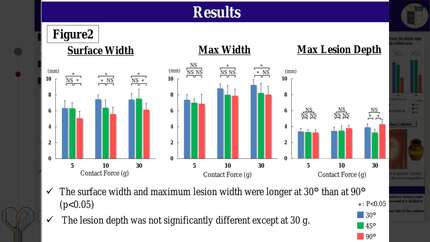
Figure 1 shows the summarized data in this study. SW and MW were longer at 30° than at 90° (SW 5 g: 6.34 ± 0.91 vs. 5.07 ± 0.87 mm; SW 10 g: 7.46 ± 0.55. vs. 5.60 ± 0.84 mm; SW 30 g: 7.42 ± 0.74. vs. 6.14 ± 0.77 mm; MW 10 g: 8.81 ± 0.55. vs. 7.89 ± 0.84 mm; MW 30 g: 9.24 ± 0.67. vs. 8.03 ± 1.04 mm, p <0.05, respectively). There were no significant differences in LD by catheter angle except at 30 g. SA was larger at 30° than at 90° (SA 5 g: 30.03 ± 0.91. vs. 23.61 ± 0.87; SA 10 g: 29.24 ± 0.55. vs. 21.27 ± 0.84; SA 30 g: 35.86 ± 0.74. vs. 31.74 ± 0.77, p <0.05, respectively). Besides, DW was longer at 30° than at 90° (DW 5 g: 4.28 ± 1.17. vs. 2.50 ± 0.32 mm; DW 10 g: 4.94 ± 0.52. vs. 2.47 ± 0.38 mm; DW 30 g: 5.34 ± 0.26. vs. 2.96 ± 0.40 mm, p <0.05, respectively). There were no significant differences in the impedance drop according to the catheter angle.
With the DT catheters, the lesion width increased at a shallower contact angle, whereas the LD did not. SA also increased at a shallower contact angle. The DT catheter created a large ablation lesion on the proximal side of the catheter, which looked like a "honey pot." (Figure 2) summarized data Image of honey pot-like lesion formation



You may be interested in