The impedance drop early after energy delivery predicts steam pops during radiofrequency ablation
European Heart Journal


Abstract
Steam pops during radiofrequency ablation (RFA) can cause serious complications. However, predictive factors for steam pops remain unclear.
To investigate predictors for steam pops.
An in vitro experiment was performed using fresh bovine left ventricular myocardium. A myocardium cut into 4-5 cm slabs was fixed at the bottom of a constant temperature bath with temperature adjusted to 36.5 degrees Celsius, and a non-pulsatile flow rate of 5 L/min was generated. Using the catheter with a laser-cut 8Fr4.0mm flexible tip, RFA was applied at 30W, 60 seconds, perpendicular catheter placement to the tissue at various contact forces (5, 10, 20, 30, 40, 50g). A total of 138 lesions were created by applying RFA 23 times at each setting. Lesion depth and width were measured after RFA.
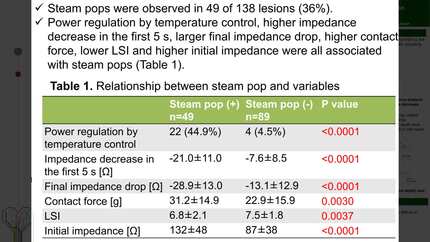
Steam pops were observed in 49 of 138 lesions (36%). The higher impedance decrease in the first 5 seconds (-21.0±11.0Ω vs. -7.6±8.5Ω, P<0.0001), the larger impedance drop from initial to minimum impedance (if steam pop occurred, minimum impedance before steam pop was applied) (-28.9±13.0Ω vs. -13.1±12.9Ω, P<0.0001), higher initial impedance (132±48Ω vs. 87±38Ω, P<0.0001), power regulation by temperature control (44.9% vs 4.5%, P<0.0001), higher contact force (31.2±14.9g vs. 22.9±15.9g, P=0.0030), larger LSI (6.8±2.1 vs. 7.5±1.8, P=0.0037) were associated with steam pops. In multivariate analysis, the high impedance drops in the first 5 seconds (OR 2.0 for each 5Ω increase, 95%CI 1.0-1.3; P=0.033) and the power regulation by temperature control (OR 7.3, 95%CI 2.2-29.9; P=0.001) were independently related. In ROC curve analysis of the impedance drops in the first 5 seconds, an optimal cut-off value of steam pops was 8.0Ω (AUC 0.85, sensitivity 88%, specificity 73%) (figure 1). Steam pops were predicted with a sensitivity of 45% and specificity of 97% using both the impedance drop ≥ 8.0Ω in the first 5 seconds and power regulation by temperature control. Lesion depth and width were associated with total impedance reduction in lesions with an impedance drop < 8.0Ω during the first 5 seconds (R²=0.14, P=0.0012 with depth, R²=0.21, P<0.0001 with width), while were not associated with in lesions with an impedance drop ≥ 8.0Ω (figure 2).
The impedance drop early after RF energy delivery may predict steam pops during RFA.
Contributors


T Miki
Author
M Nakai
Author
F Yoshikawa
Author
K Takai
Author
K Fujita
Author
M Nishibori
Author
T Maruyama
Author
You may be interested in