Efficacy of percutaneous stellate ganglion block according to ventricular arrhythmia cycle length: a post-hoc sub-analysis of the STAR study
European Heart Journal


Abstract
Percutaneous stellate ganglion block (PSGB) is an effective treatment for patients with electrical storm (ES). However, literature is scarce about a possible relation between ventricular arrhythmias’ cycle length and the effectiveness extent of PSGB.
To assess whether the PSGB efficacy is affected by the arrhythmias’ cycle length prior to the procedure.
This is a post-hoc sub-analysis of the STAR study (STellate ganglion block for Arrythmic stoRm), a multicentre observational study aimed to assess PSGB’s effectiveness and safety in ES patients [1]. According to both the type and the median cycle of the latest ventricular arrhythmia before PSGB we considered 3 groups: ventricular fibrillation (VF), fast ventricular tachycardia (VT) and slowVT. The primary outcome is the number of treated arrhythmic episodes (with ATPs and/or DC-shocks) in the hour immediately after the PSGB as compared to the hour immediately before. The secondary outcome was the extent of the reduction of the number of ATPs/DC-shocks delivered from the hour before to the hour immediately after the PSGB.
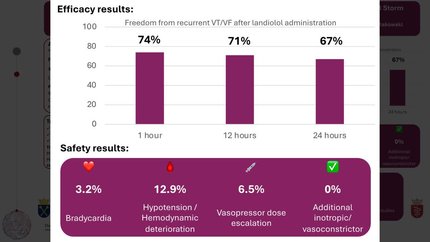
The original study included 184 PSGBs performed on 131 patients. We excluded 32 PSGBs with a continuous infusion and 13 PSGBs with an unknown VT cycle. The median VT cycle was 375 msec, so the final dataset of 139 PSGBs from 112 patients was divided as follows: 51 VF; 44 fastVT (VT cycle <375 msec) and 44 slowVT (VT cycle ≥375 msec). The number of treated arrhythmic episodes in the first hour after every PSGB was significantly lower compared to the first hour before in all the three groups [VF: 0 (IQR, 0-1) vs 5 (IQR, 2-8), p<0.001; fastVT: 0 (IQR, 0-0) vs 1 (IQR, 0-6.5), p<0.001; slowVT: 0 (IQR, 0-0) vs 1 (IQR, 0-4.5), p=0.001] (Figure 1). The Hodges-Lehman median difference of treated arrhythmic episodes between the hour after and before the PSGB was significantly higher in VF group [-4 (-3 to -6)] than in the fast-VT [-2 (-1 to -4)] and slow-VT [-1 (0 to -2.5)] (Figure 2). Analysing the reduction (delta less than zero) of the number of ATPs/DC-shocks from the hour before to the hour immediately after the PSGB, a significant trend was observed across the three groups (Jonckheere-Terpstra trend p<0.001) and a significant difference was observed comparing slow-VT vs VF [0 (IQR, -3 to 0) vs -4 (IQR, -7 to -1)] and fast-VT versus VF [-1 (IQR, -4.5 to 0) vs -4 (IQR, -7 to -1)], but not comparing slow-VT versus fast-VT [0 (IQR, -3 to 0) vs -1 (IQR, -4.5 to 0)]. VF was a predictor of the reduction of treated arrhythmic episodes at univariable analysis and after correction for the number of treated arrhythmic episodes in the hour immediately before PSGB and of left ventricular ejection fraction (OR 7.8, 95%CI 2.1-28.6).
PSGB is an effective treatment for ES in patients with all type of ventricular arrhythmias. However, its effectiveness was more pronounced in patients with VF or rapid ventricular tachycardia.
Contributors


R Rordorf
Author
V Dusi
Author
F M Cauti
Author
L Frigerio
Author
M Casula
Author
G Sangiorgi
Author
S Persampieri
Author
G Dell'era
Author
C Colombo
Author
G Mugnai
Author
F Notaristefano
Author
G D'angelo
Author
G M De Ferrari
Author
S Savastano
Author
You may be interested in