Comprehensive risk factor analysis for sick sinus syndrome: an analysis of genetic, sociodemographic, clinical and laboratory data from the UK Biobank
European Heart Journal


Abstract
Sick sinus syndrome (SSS) and atrial fibrillation (AF) frequently coexist and interact bidirectionally, often to initiate and perpetuate each other. The polygenic risk score (PRS) assesses the cumulative risk of disease onset based on variations at multiple genetic loci. To date, no specific PRS has been established for SSS. This study investigates the impact of clinical, sociodemographic, laboratory, and genetic factors, which were represented by PRS for AF due to the absence of a specific PRS for SSS on predicting the incidence of SSS.
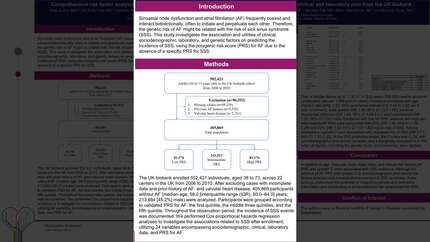
The UK biobank enrolled 502,421 individuals, aged 38 to 73, across 22 centres in the UK locations, from 2006 to 2010. After excluding cases with incomplete data, prior history of AF, and valvular heart disease, 405,869 participants without AF (median age, 58.0 [interquartile range (IQR), 50.0–64.0] years; 213,684 [45.2%] male) were analyzed. Participants were categorized into three groups according to a validated PRS for AF: the first quintile the middle three quintiles, and the fifth quintile. Throughout the observation period, the incidence of SSS event was documented.
During a follow-up period of 11.9 (IQR 11.1-12.6) years, a total of 769 cases of Sick sinus syndrome were identified. The Kaplan-Meier analysis demonstrated a progressive increase in the incidence of SSS as the quintiles of AF-related PRS increased. (Log-rank: P <0.001) Among 24 variables, statistically significant hazard ratios were observed with age, male sex, body mass index (BMI), systolic blood pressure (SBP), diastolic blood pressure (DBP), previous myocardial infarction (MI), history of malignant neoplasm, hypertension, diabetes mellitus, cystatin C, and AF PRS. In the prediction model for Sick Sinus Syndrome, the C-index for the sociodemographic model was 0.753. This increased to 0.764 with the addition of clinical factors, to 0.765 with the inclusion of biomarkers, and further to 0.769 upon adding genetic factors.
Our study found significant associations between the incidence of SSS and a range of sociodemographic, clinical, laboratory, and genetic factors, including age, male sex, BMI, blood pressure, and medical history. Notably, the AF PRS also showed relevance, suggesting its potential utility in developing one for SSS in the absence of a dedicated PRS for SSS.



You may be interested in