Predictors of discordance in estimating the presence of chronic kidney disease among patients with atrial fibrillation and impact on prescription of anticoagulants and cardiovascular outcomes
European Heart Journal


Abstract
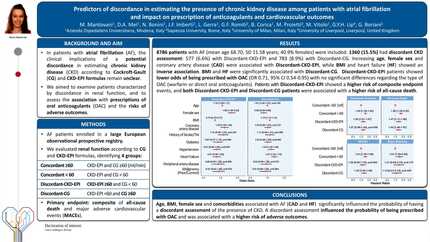
In patients with atrial fibrillation (AF), the prevalence, predictors and clinical implications of a potential discordance in estimating the presence/absence of chronic kidney disease (CKD) according to Cockroft-Gault (CG) and CKD-EPI formulas remain unclear.
To examine patients characterized by discordance in evaluation of renal function, specifically with regard to the threshold for defining the presence of CKD according to an estimated glomerular filtration rate (eGFR) < 60 ml/min, in a large cohort of European AF patients, and to assess the association with prescriptions of oral anticoagulants (OAC) and the risks of adverse outcomes.
Data related to AF patients enrolled in a large European observational prospective registry with an average follow up of 645.2 days were analysed. We evaluated renal function for assessing the presence of CKD according to CG and CKD-EPI formulas and we categorized the population in four groups: eGFR ≥ 60 ml/min according both to CG and CKD-EPI (Concordant ≥ 60); < 60 ml/min according to both formulas (Concordant <60); CG <60 ml/min and CKD-EPI ≥60 ml/min (Discordant-CKD-EPI), CG ≥ 60 ml/min and CKD-EPI <60 ml/min (Discordant-CG). Logistic regression analyses were used to assess factors associated with a Discordant assessment of CKD and its association with OAC therapy. Cox regression analysis was used to determine association between categories and the risk of adverse outcome. The primary endpoint was a composite of all-cause death and major adverse cardiovascular events (MACEs).
8.786 patients with AF (mean age 68.70, SD 11.58 years; 40.9% female) were included in the analysis. 1360 (15.5%) of them had Discordant CKD assessment: 577 (6.6%) with Discordant-CKD-EPI and 783 (8.9%) with Discordant-CG. Increasing age, female sex and coronary artery disease (CAD) were associated with Discordant-CKD-EPI, while BMI and heart failure (HF) showed an inverse association (Figure 1). Conversely, BMI and HF were factors significantly associated with Discordant-CG.
Discordant-CKD-EPI patients showed lower odds of being prescribed with OAC therapy (odds ratio [OR] 0.71, 95% confidence interval [CI] 0.54-0.95) with no significant differences regarding the type of OAC therapy (warfarin or direct oral anticoagulants).
At Cox regression analysis, patients with Discordant-CKD-EPI showed a higher risk of composite endpoint events (Figure 2) and both Discordant-CKD-EPI and Discordant-CG patients were associated with a higher risk of all-cause death.
Age, BMI, female sex and comorbidities associated with AF (CAD and HF) significantly influenced the probability of having a discordant assessment of the presence of CKD, according to estimation of renal function impairment using CG or CKD-EPI formulas, respectively. A discordant assessment of CKD influenced the probability of being prescribed with OAC and was associated with a higher risk of adverse outcomes.
Contributors


N Bonini
Author
J F Imberti
Author
L Gerra
Author
M Mantovani
Author
G F Romiti
Author
B Corica
Author
M Proietti
Author
M Vitolo
Author
G Y H Lip
Author
G Y H Boriani
Author
You may be interested in