The Mutscore metapredictor: a new application of artificial intelligence in cardiogenetics
European Heart Journal


Abstract
The rapid development of high-throughput next generation sequencing has shifted the limits of genetic knowledge from variant sequencing to variant interpretation. The current standards recommend that sequence variants are interpreted according to a comprehensive analysis including, among others, computational data. The two major types of in-silico predictive tools encompass those predicting the theoretical variant effect on splicing and algorithms predicting the potential damage of missense variants. However, overall for missense variants, prediction accuracy is often limited and results are sometimes inconsistent between software programs.
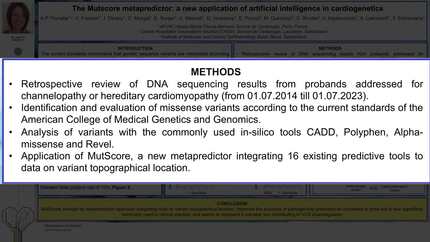
We aimed at testing the predictive performance of a new predictive algorithm (Mutscore) for missense variants based on a machine learning approach, in our cohort of families referred for hereditary cardiac diseases.
We retrospectively reviewed DNA sequencing results from 230 families (from 01.07.2014 till 01.07.2023) addressed to our center for channelopathy or hereditary cardiomyopathy. Missense variants were identified and evaluated according to the current standards of the American College of Medical Genetics and Genomics. Variants were analysed with the commonly used in-silico tools CADD, Polyphen, Alpha-missense and Revel. We further applied the Mutscore, a new metapredictor integrating 16 existing predictive tools to data on variant topographical location.
Among our 230 families, we detected 252 missense variants (class I-II 2.4%, class III 62.3%, class IV and V 15.9% and 19.4% respectively). We observed a significant positive correlation (r = 0.59, p=0.000) between the Mutscore and the interpretation of variants according to standards. The Mutscore had a better predictive performance than Polyphen (AUC 0.83 vs 0.67, p=0.007), Alpha-missense (AUC 0.87 vs 0.79, p=0.047) and CADD (AUC 0.87 vs 0.70, p=0.0001). Compared to Revel, the Mutscore had a comparable predictive performance (0.89 vs 0.87, p=NS), but a better sensitivity (75% vs 66%) at the maximum tolerated false positive rate of 10%. Figure 1. Focusing on variants of uncertain significance (VUS), we applied Mutscore cut-off values which were identified to reclassify variants in our previous study (1). Importantly, the Mutscore reclassified 45% of VUS into likely benign/pathogenic variants. Figure 2.
The Mutscore, through its metaprediction approach integrating data on variant topographical location, improves the accuracy of pathogenicity prediction as compared to three out of four algorithms commonly used in clinical practice, and seems to represent a valuable tool contributing to VUS disambiguation.
Contributors


V Fressart
Author
I Denjoy
Author
C Morgat
Author
E Surget
Author
A Messali
Author
V Algalarrondo
Author
G Vedrenne
Author
E Pruvot
Author
M Quinodoz
Author
C Rivolta
Author
A Leenhardt
Author
F Extramiana
Author
You may be interested in