Prognostic value of diffuse high-risk plaque in patients with acute myocardial infarction: a three-vessel optical coherence tomography study
European Heart Journal


Abstract
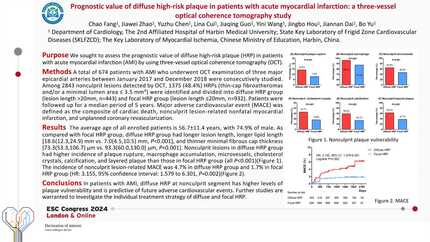
Existing evidence has identified that high-risk plaque (HRP) characterized by a thin-cap fibroatheroma and/or a minimal lumen area ≤ 3.5 mm² were indicative of future cardiovascular events. Diffuse coronary artery disease also contributes to the poor prognosis.
The present study aims to assess the prognostic value of diffuse HRP in patients with acute myocardial infarction (AMI) by using three-vessel optical coherence tomography (OCT).
A total of 674 patients with AMI who underwent OCT examination of three major epicardial arteries between January 2017 and December 2018 were consecutively studied. Among 2843 nonculprit lesions detected by OCT, 1375 (48.4%) HRPs were identified and divided into diffuse HRP group (lesion length >20mm, n=443) and focal HRP group (lesion length ≤20mm, n=932). Patients were followed up for a median period of 5 years. Major adverse cardiovascular event (MACE) was defined as the composite of cardiac death, nonculprit lesion-related nonfatal myocardial infarction, and unplanned coronary revascularization.
The average age of all enrolled patients is 56.7±11.4 years, with 74.9% of male. As compared with focal HRP group, diffuse HRP group had longer lesion length [25.8(23.0,30.8) mm vs. 13.2(9.8,16.1) mm, P<0.001], longer lipid length [18.6(12.3,24.9) mm vs. 7.0(4.5,10.5) mm, P<0.001], and thinner minimal fibrous cap thickness [73.3(53.3,106.7) μm vs. 93.3(60.0,130.0) μm, P<0.001], whereas mean lipid arc was comparable between the two groups. The prevalence of nonculprit plaque rupture (14.2% vs. 7.8%, P<0.001) was significantly higher in diffuse HRP group than that in the focal HRP group. Nonculprit lesions in diffuse HRP group had higher incidence of macrophage accumulation, microvessels, cholesterol crystals, calcification, and layered plaque phenotype than those in focal HRP group (all P<0.001). The incidence of nonculprit lesion-related MACE was 4.7% in diffuse HRP group and 1.7% in focal HRP group [HR: 3.155, 95% confidence interval: 1.579 to 6.301, P=0.002].
In patients with AMI, diffuse HRP at nonculprit segment has higher levels of plaque vulnerability and is predictive of future adverse cardiovascular events. Further studies are warranted to investigate the individual treatment strategy of diffuse and focal HRP. Nonculprit plaque vulnerability MACE


You may be interested in