Trend in culprit plaque phenotype in ACS patients over the past 10 years
European Heart Journal


Abstract
Although the incidence of acute myocardial infarction has been declining over the past decade, the etiology of this trend is unknown. One possible explanation could be changes in coronary plaque phenotype.
The aim of this study was to investigate the changes in plaque characteristics over the last 10 years.
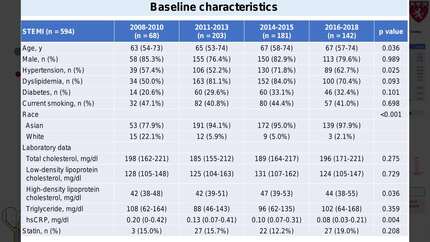
Patients who presented with acute coronary syndrome and underwent preintervention optical coherence tomography (OCT) imaging from 2008 to 2018 were included. Patients were divided into 4 periods: (P1) 2008-2010, (P2) 2011-2013, (P3) 2014-2015, and (P4) 2016-2018. Plaque characteristics at culprit lesion in each period were compared.
Among 1144 patients, 594 (51.9%) presented with ST-segment–elevation myocardial infarction (STEMI). The prevalence of thin-cap fibroatheroma decreased from P1 to P4 in both STEMI group (57.4% to 24.6%, P<0.001) and non-ST-segment elevation acute coronary syndrome (NSTE-ACS) group (40.4% to 17.0%, P<0.001) (Figure).
The prevalence of OCT features of plaque vulnerability has decreased over the past 10 years. A decrease in plaque vulnerability may explain the favorable trend in cardiovascular events. Prevalence of thin-cap fibroatheroma
Contributors

D Kinoshita
Author
T Niida
Author
D Fujimoto
Author
H Lee
Author
I Mcnulty
Author
M Takano
Author
K Mizuno
Author
I Jang
Author
You may be interested in