Predictive value of plaque characteristics assessed by coronary computed tomography angiography and optical coherence tomography for identification of lesions causing ischemia
European Heart Journal


Abstract
In patients with intermediate coronary stenosis, the functional assessment with fractional flow reserve (FFR) and the anatomical assessment with optical coherence tomography (OCT) have been widely used in clinical practice. Additionally, coronary computed tomography angiography (CTA) is commonly used non-invasive imaging technique for evaluating suspected coronary artery disease before being referred for angiography.
This study sought to investigate the association between FFR and plaque characteristics assessed by coronary CTA and OCT in intermediate coronary stenosis.
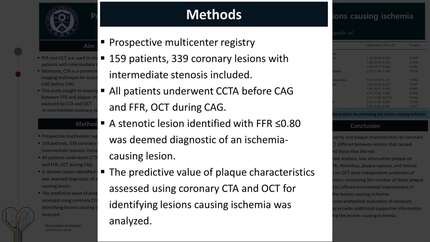
Based on the prospective multicentre registry, a total of 159 patients including 339 coronary lesions with intermediate stenosis were included. All patients underwent coronary CTA before being referred for coronary angiography and both FFR measurement and OCT examination were performed during angiography. The stenotic lesion with FFR ≤0.80 was considered diagnostic of lesion causing ischemia. The predictive value of plaque characteristics assessed by coronary CTA and OCT for identifying lesions causing ischemia was analyzed.
Stenosis severity and plaque characteristics on coronary CTA and OCT were different between the lesions causing ischemia versus not causing ischemia. On multivariate analysis, low attenuation plaque on coronary CTA (odds ratio [OR]= 2.78; P=0.038) and thrombus (OR=5.13; 0.042), plaque rupture (OR=3.25; P=0.017), and intimal vasculature on OCT (OR=2.57; P=0.012) were independent predictors for the lesions causing ischemia. Increasing number of these plaque characteristics offered incremental improvement in predicting the lesions causing ischemia.
Comprehensive anatomical evaluation of coronary stenosis may be able to provide additional supportive information for predicting the lesions causing ischemia.
Contributors

G Park
Author
Severance Cardiovascular Hospital, Yonsei University College of Medicine Seoul , Korea (Republic of)

Y J Lee
Author
Severance Cardiovascular Hospital, Yonsei University College of Medicine Seoul , Korea (Republic of)
J Y Jeung
Author
J Lee
Author
J Shin
Author
I T Jin
Author
S H Lee
Author

You may be interested in