Identification of ischemia with no obstructive coronary arteries using 13N-ammonia positron emission tomography-derived myocardial strain ratio
European Heart Journal


Abstract
Ischemia with no obstructive coronary arteries (INOCA) is a chronic health problem with poor prognosis and remains challenging to diagnose. 13N-ammonia positron emission tomography (NH3-PET) is the most reliable method for detecting INOCA. We recently developed a unique myocardial strain analysis for NH3-PET to detect ischemia-related motion abnormalities.
We examined the usefulness of NH3-PET strain analysis to identify patients with INOCA.
Overall, 98 patients with non-obstructive coronary arteries who underwent adenosine-stress NH3-PET were enrolled. INOCA was defined based on the ESC guidelines. Using an original feature-tracking algorithm dedicated to NH3-PET, the circumferential strain was calculated. Myocardial strain ratio (MSR) was defined as the ratio of strains at stress and rest. In addition, global myocardial flow reserve (MFR) was obtained.
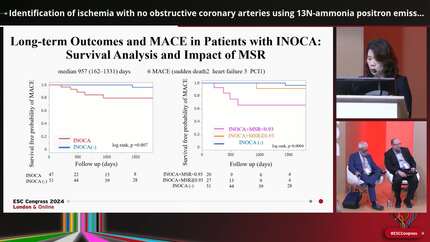
Finally, forty-seven patients were diagnosed with INOCA, and 51 without INOCA. Global MFR were significantly lower in patients with INOCA than in those without INOCA (1.82 ± 0.52 vs. 2.65 ± 0.65, p<0.0001). MSR were significantly lower in patients with INOCA than in those without INOCA (0.94 ± 0.11 vs. 1.04 ± 0.12, p<0.001). Receiver-operating characteristic analysis showed that using the optimal cutoff of the MSR, INOCA could be diagnosed with area under the curve of 0.71. At a median follow-up of 957 days, Kaplan–Meier analysis revealed that the survival rate worsened in patients with INOCA and low MSR (log-rank test, p<0.001).
MSR derived from feature-tracking of NH3-PET is reduced in patients with INOCA. It might suggest a predictive value to identify microvascular dysfunction or related motion abnormalities in patients with INOCA.
Contributors


You may be interested in