Prognostic value of cardiac magnetic resonance global circumferential strain assessed by feature tracking techniques in asymptomatic patients with significant aortic regurgitation
European Heart Journal


Abstract
Cardiac magnetic resonance feature tracking (CMR-FT) deformation techniques have gained significant interest in recent years. They provide a comprehensive evaluation of myocardial function and improve the reproducibility of echocardiography strain techniques.
The aim of this study was to evaluate whether CMR-FT deformation parameters play a role predicting worse clinical evolution in patients with chronic significant aortic regurgitation (AR) not meeting guidelines intervention criteria.
We included 85 patients with significant AR (moderate, moderate/severe, and severe) referred for CMR. Only asymptomatic patients with preserved left ventricle ejection fraction (LVEF) were considered for inclusion. Other concomitant myocardiopathies were excluded. Conventional functional left chambers parameters as well as myocardial deformation were evaluated, including global longitudinal strain (GLS), global circumferential strain (GCS) and global radial strain (GRS). A composite clinical major outcome was assessed, including admission heart failure admission, need for aortic valvule replacement and all-cause mortality.
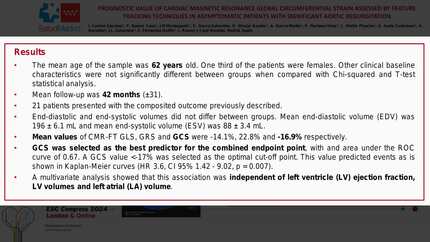
The mean age of the sample was 62 years old. One third of the patients were females. Other clinical baseline characteristics were not significantly different between groups when compared with Chi-squared and T-test statistical analysis. Mean follow-up was 42 months (±31). 21 patients presented with the composited outcome previously described. End-diastolic and end-systolic volumes did not differ between groups. Mean end-diastolic volume (EDV) was 196 ± 6.1 mL and mean end-systolic volume (ESV) was 88 ± 3.4 mL. Mean values of CMR-FT GLS, GCS and GRS were -14.1%, 22.8% and -16.9% respectively. GCS was selected as the best predictor for the combined endpoint point, with and area under the ROC curve of 0.67. A GCS value <-17% was selected as the optimal cut-off point. This value predicted events as is shown in Kaplan-Meier curves (HR 3.6, CI 95% 1.42 - 9.02, p = 0.007). A multivariate analysis showed that this association was independent of left ventricle (LV) ejection fraction, LV volumes and left atrial (LA) volume.
CMR-FT deformation parameters are impaired in significant AR patients even if intervention criteria are not met. A value of GCS < -17% in this population could predict a worse clinical evolution and emerges as a promising new tool helping clinical decision making in this challenging population. Kaplan-Meier curve free-event survival
Contributors



You may be interested in