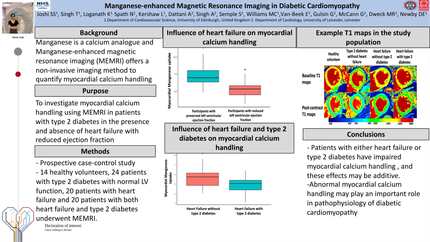
Manganese-enhanced magnetic resonance imaging in diabetic cardiomyopathy
European Heart Journal


Abstract
To investigate myocardial calcium handling using manganese-enhanced magnetic resonance imaging in patients with type 2 diabetes in the presence and absence of heart failure with reduced ejection fraction.
In a prospective case-control study, 14 healthy volunteers, 24 patients with type 2 diabetes with normal left ventricular function (early stages of diabetic cardiomyopathy), 20 patients with heart failure with reduced ejection fraction, and 20 patients with both heart failure with reduced ejection fraction and type 2 diabetes (late stages of diabetic cardiomyopathy) underwent cardiac manganese-enhanced magnetic resonance imaging.
Mean myocardial manganese uptake was 8.3±1.3 mL/100 g of tissue/min in healthy volunteers, falling to 6.5±0.9 mL/100g of tissue/min in patients with type 2 diabetes and lowest in patients with heart failure (4.5±1.0 mL/100g of tissue/min). Patients in late stages of diabetic cardiomyopathy had lower myocardial manganese uptake compared to patients in early stages of diabetic cardiomyopathy (4.9±0.7 versus 6.5±0.9, p<0.001). Furthermore, patients with both type 2 diabetes and heart failure had suppressed myocardial manganese uptake compared to patients with heart failure without type 2 diabetes (4.9±0.8 versus 5.7±1.1 mL/100g of tissue/min, p=0.01). On multivariable analysis, type 2 diabetes and left ventricular ejection fraction were the independent predictors of myocardial manganese uptake in patients with heart failure, after adjusting for age, sex, ischaemic heart disease, hypertension, and hyperlipidaemia.
Patients with either heart failure or type 2 diabetes have impaired myocardial calcium handling, and these effects appear to be additive. Type 2 diabetes and impaired left ventricular systolic dysfunction are independent predictors for abnormal myocardial calcium handling, and this may play an important role in the pathogenesis of diabetic cardiomyopathy.
Contributors

S Joshi
Author
University of Edinburgh Edinburgh , United Kingdom of Great Britain & Northern Ireland

T Singh
Author
K Loganath
Author
N Spath
Author
L Kershaw
Author
A Dattani
Author
A Singh
Author
S Semple
Author
M Williams
Author
E Van-Beek
Author
G Gulsin
Author
G Mccann
Author
M Dweck
Author
D E Newby
Author
You may be interested in