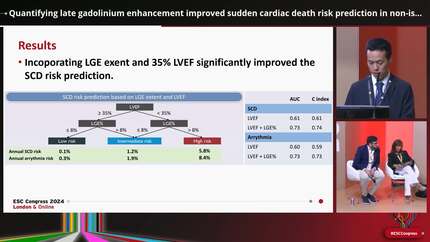
Quantifying late gadolinium enhancement improved sudden cardiac death risk prediction in non-ischemic dilated cardiomyopathy
European Heart Journal


Abstract
While previous studies have proved the late gadolinium enhancement (LGE) was associated with poor prognosis in non-ischemic dilated cardiomyopathy (DCM), the optimal method for LGE quantification and the ability of LGE extent in identifying sudden cardiac death (SCD) remain less clarified.
This study sought to compare the reproducibility of LGE quantification methods and explore the asssociation between LGE extent and SCD endpoint in DCM patients.
In this prospective study, LGE was quantified by the 2-6 standard deviations (SD) above the remote myocardium and full-wide half-maximum (FWHM) methods. The primary endpoint was SCD and arrythmia endpoint included SCD and aborted SCD. Reproducibility of LGE quantification was measured by Bland-Altman analysis and intra-class correlation coefficients (ICC). Competing risk regression analysis, C-index and area under the curve (AUC) were performed to identify the prognostic value.
Among the 770 patients, 336 (44%) patients had LGE. FWHM demonstrated the best reproducibility compared with other quantification methods (intraobserver variability: ICC = 0.94, mean bias: -0.43 ± 4.89%; interobserver variability: ICC = 0.90, mean bias: -2.65 ± 6.40%). After a median follow-up of 49 months, SCD occurred in 61 (8%) patients and arrythmia endpoint occurred in 87 (11%) patients. Among all quantification method, LGE extent measured by FWHM showed the highest predictive value of SCD (C index: 0.72) and arrythmia events (C index: 0.71) than other methods. In the competing risk analysis, LGE extent was independently association with SCD (Hazard ratio [HR] 1.05, 95% confidence interval [CI] 1.03 - 1.07, P < 0.001) and arrythmia endpoint (HR 1.05, 95% CI 1.03 - 1.06, P < 0.001). LGE extent >8% showed significantly higher risk of SCD and arrythmia endpoint than those with LGE extent ≤8% (P < 0.001). Incoporating LGE exent and 35% left ventricular ejection fraction (LVEF) significantly improved the SCD (C index: 0.74 vs 0.61, P < 0.001) and arrythmia endpoint (C index: 0.73 vs 0.59, P < 0.001) prediction compared with LVEF.
FWHM demonstrated best reproducibility and highest SCD prediction ability among LGE quantification methods. Adding LGE extent to LVEF significantly improved the predictive value of SCD and arrythmia endpoint.

You may be interested in