Predictors of debulking devices use by coronary artery calcification classification using cardiac CT
European Heart Journal


Abstract
Multi-slice computed tomography (CT) is useful for the non-invasive detection and quantification of coronary calcium burden. However, a definitive parameter based on CT imaging for predicting the need for debulking devices, such as rotational atherectomy (RA) and orbital atherectomy (OAS), has yet to be established.
We aimed to develop a calcification risk score using cardiac CT to predict the use of debulking devices during coronary intervention.
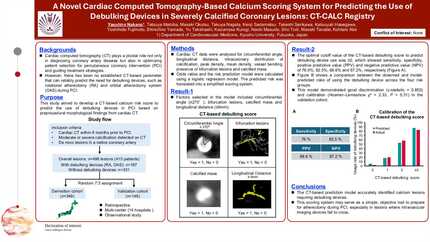
In this retrospective, multi-center, observational study in Japan, patients who underwent percutaneous coronary intervention (PCI) were screened. Inclusion criteria were (1) cardiac CT within 6 months prior to PCI, (2) moderate or severe coronary calcification detected on CT, and (3) de novo lesions in a native coronary artery. A total of 349 lesions in 343 patients from 13 hospitals, there were 124 lesions that were treated with debulking devices and 225 lesions without debulking devices. Cardiac CT images were analyzed for circumferential degree, longitudinal length, intracoronary distribution of calcification, peak density, mean density, vessel bend and presence of bifurcation lesions. Data from a random two-thirds (the derivation cohort, n=247) were used to develop a new risk prediction model, which was then tested in the remaining one-third (the validation cohort, n=102). Odds ratios and the risk prediction model were developed using a logistic regression model. The predicted risk was translated into a simplified scoring system (Figure 1A).
RA was used in 111 lesions and OAS in 23 lesions. Factors selected in the model included circumferential degree (≥270°: 3 points), bifurcation (2 points), longitudinal length (≥8mm: 1 point), and mean density (≥600 HU: 1 point) (Figure 1B). This model demonstrated good discrimination (c-statistic=0.772) and calibration (Hosmer–Lemeshow χ²-statistic=0.885; P=0.64) in the validation cohort (Figure 2).
The new prediction model based on cardiac CT performed well in predicting the need for debulking devices. This could serve as an objective tool to support a clinical decision to use debulking devices even in cases where intravascular imaging is not applicable. Study flow and Cardiac CT calcium score Discrimination and Calibration
Contributors

M Okutsu
Author
K Sadamatsu
Author
T Nagata
Author
T Serikawa
Author
K Hasegawa
Author
Y Fujimoto
Author
S Yamada
Author
Y Takahashi
Author
K Kurogi
Author
N Masuda
Author
M Nakano
Author
S Torii
Author
M Tanabe
Author
T Matoba
Author
You may be interested in